Products · Cooking oils & fats · Algae Cooking Club
Algae Cooking Club Algae Cooking Oil
Reader ratings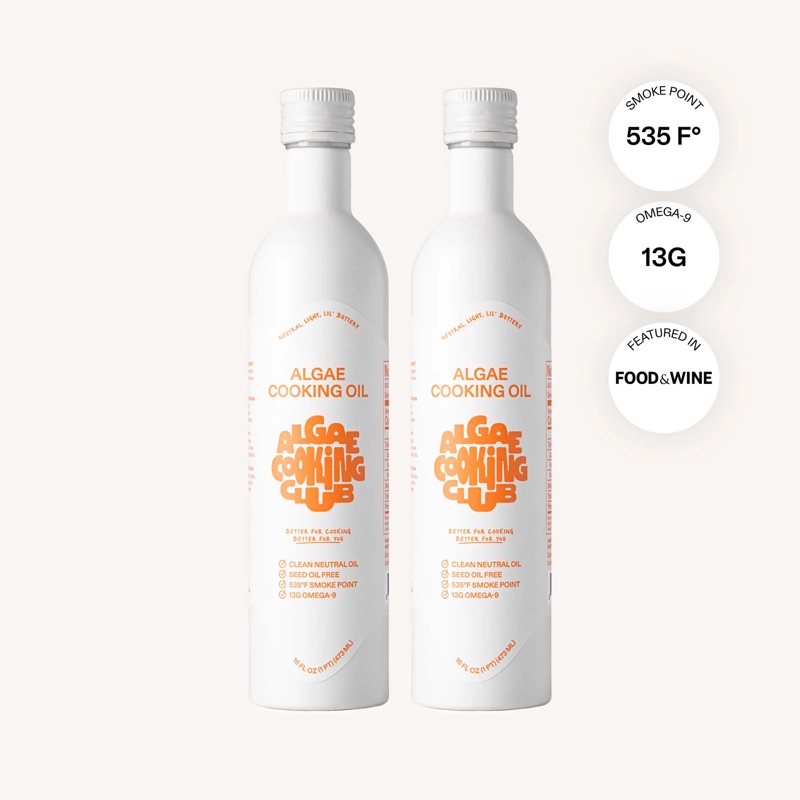
A high-oleic oil from microalgae fed sugar in tanks: 93% monounsaturated, no omega-3. Two certifiers list it, but the maker names no strain or producer, does not say whether the strain is genetically modified, and gives no bottle material.
Best for Cooks curious about a new, neutral, high-heat oil who accept that it is a novel food with a thin independent record.
- Our quality rating
- Fair (3 of 5)
- Price range
- Premium
- Verified marks
- Seed Oil Free Certified, Glyphosate Residue Free (Detox Project)
- Size
- 16 fl oz (473 mL) bottle; two-bottle and four-bottle packs are cheaper per bottle
approx. $23 for 16 fl oz (473 mL)
See it on Algae Cooking Club’s site →We are not affiliated with Algae Cooking Club. This link goes to the maker’s own page, with no tracking code. How we're funded.
Reader ratings & reviews
– out of 5
Loading ratings…
Rating breakdown
- 5 stars 0
- 4 stars 0
- 3 stars 0
- 2 stars 0
- 1 star 0
Have this product? Please rate it.
Check your email
We sent a sign-in link to . Click it and you’ll come straight back here, signed in. It expires in 15 minutes; check your spam folder if it doesn’t show up. Thank you for helping the community!
Your review
Reviews are personal experiences, not research, and they never change our quality ratings. Every review is read by our team before it appears.
How we evaluated it
Why we chose it What put it on our list
- Two certifier listings are current. The Seed Oil Free Alliance lists the oil as certified since November 2024, with laboratory testing for added oils. The Detox Project lists it as Glyphosate Residue Free.
- The fat profile is stated: about 93% monounsaturated (13 g a tablespoon), 0.5 g of saturated fat a tablespoon, and linoleic (omega-6) acid under 3%. The maker also says plainly that it has no omega-3.
- The ingredients are algae oil and vitamin E. The maker says the oil is made without pesticides or chemical solvents, and a 2024 news report says it is expeller pressed.
- It is the only consumer algae cooking oil we found on sale. Thrive Culinary Algae Oil, the earlier one, was discontinued by Corbion in 2020.
Trade-offs What to weigh before you buy
- The maker does not name the algae or the producer. Its product page and FAQ, and the press coverage we read, give neither the species or strain nor the company or factory that makes the oil. It does not say whether the strain is genetically modified and makes no non-GMO claim. (“Glyphosate residue free” is a different test.)
- FDA’s GRAS letter for a similar high-oleic algal oil from TerraVia and Corbion (GRN 754, 2018) describes a Prototheca moriformis strain developed by chemical and UV mutagenesis and then genetic transformation. Algae Cooking Club’s oil may be made differently, and we cannot tell.
- The published safety work on similar oils is a 13-week rat study and genotoxicity tests, not human trials, and we found no human trials of algal cooking oil. The health case rests on its fat profile. See which oils are safe for high-heat cooking, which says stability matters more than the smoke point.
- The bottle in the maker’s photos is opaque white with a screw cap, but no page says what it is made of, and we saw no date. The 535°F smoke point is the maker’s figure. At about $1.44 a fluid ounce it costs more than Marianne’s avocado oil (about $1.01).
What to know Details worth knowing first
Algae Cooking Club sells the only consumer algae cooking oil we could find on sale. The older Thrive Culinary Algae Oil, from TerraVia and then Corbion, was discontinued in 2020. The oil is made by feeding sugar to microalgae in stainless steel tanks and pressing out the fat. It comes out mostly monounsaturated, with little saturated fat, and the maker says plainly that it has no omega-3.
What we could not establish is what the oil actually is. The maker does not name the algae, the company that produces the oil, or whether the strain is genetically modified, and our criteria for fermentation oils ask for exactly those answers. The regulatory letter we read for a similar algal oil describes a strain that was mutated and then genetically modified. Two certifiers list the oil, but they test for seed oils and glyphosate, not for identity or freshness.
The health case is the fat profile, nothing more. We list it at a 3 on that basis, with a notice: we are asking the company for the strain, the producer, whether it is genetically modified, and what the bottle is made of.
Quality & testing How it measures up against our checklist
- Third-party tested
- Yes
- Tested by
- Seed Oil Free Alliance; The Detox Project (narrow tests)
| What we checked | What we found |
|---|---|
| Purity you can check Verified | Seed Oil Free Alliance and Detox Project both list the product. Those tests cover added seed oils and glyphosate, not the identity or freshness of the oil. “Third-party tested” on the page names no lab. |
| Fat profile stated, with omega-6 Maker’s claim | 93% monounsaturated, 13 g per tablespoon, 0.5 g saturated per tablespoon, linoleic acid under 3% in the maker’s comparison table. No omega-3. |
| Made without solvents Maker’s claim | “Without … chemical solvents”, from the maker’s FAQ, and expeller pressing, from a 2024 news report. No process document. |
| Packaging that blocks light, with a date Not verified | Opaque white bottle in the maker’s photos. Material not stated and no date seen. |
| A traceable source Not verified | No algae species or strain, producer or factory is named. |
| Production organism and GM status Not verified | Not stated. No non-GMO claim. |
| Notices and recalls Verified | We found no California Prop 65 notice and no FDA or CPSC recall naming Algae Cooking Club when we searched on 22 Oct 2026. |
What the labels mean
- Verified We opened an independent record that confirms it: a certifier’s listing, a regulator’s list or a lab report. It is linked under Sources.
- Maker’s claim The maker says so on its own page or label. We read it but found no independent record.
- Not verified We looked and could not confirm it, or the maker does not say. Treat it as unknown.
Sources Where our facts come from
- Algae Cooking Club Algae Cooking Oil product page. Maker’s page. Price $22.99 for one bottle, $41 for two and $78 for four on 22 Oct 2026. Open ↗
- Algae Cooking Club FAQ. Maker’s page. Fermentation in stainless steel tanks; no omega-3; says “microalgae” and nothing more specific about the organism. Open ↗
- Seed Oil Free Alliance: Algae Cooking Club certified products. Certifier or regulator listing. Certified since November 2024; three products. The Alliance licenses its seal for a fee. Open ↗
- The Detox Project: Glyphosate Residue Free certified products. Certifier or regulator listing. Lists Algae Cooking Club’s Algae Cooking Oil. Open ↗
- FDA GRAS notice inventory: GRN 754, algal oil (88% oleic acid) from Prototheca moriformis strain S6697. Independent source. FDA’s 2018 no-questions letter to Corbion. It describes the production strain and process for a similar oil, not necessarily this one. Open ↗
- FoodNavigator: Corbion discontinues Thrive algae oil (August 2020). Independent source. Open ↗
- The Spoon: Algae Cooking Club debuts a cooking oil made from fermented microalgae (February 2024). Independent source. Describes sugar-fed bioreactors and expeller pressing. Open ↗
- Szabo et al. (2014), Food and Chemical Toxicology: safety evaluation of an oleic-rich triglyceride oil from microalgal fermentation (PMID 24394481). Independent source. A 13-week rat feeding study and genotoxicity tests of a similar oil. No human trials. Open ↗
- California Attorney General: Prop 65 60-day notice search. Certifier or regulator listing. Searched by alleged violator on 22 Oct 2026; no notice named Algae Cooking Club. Open ↗
Alternatives Other options to compare
- Zero Acre Oil Another fermentation oil, made from sugarcane by a microbe its page does not name. About 93% monounsaturated fat on its page.
- Marianne’s Harvest Classic Avocado Oil A refined avocado oil with an independent purity test, two current certifier listings and dark glass. About $17 for 500 mL.