Products · Tea & teaware · Matchaful
Matchaful Hikari Single Origin Matcha
Reader ratings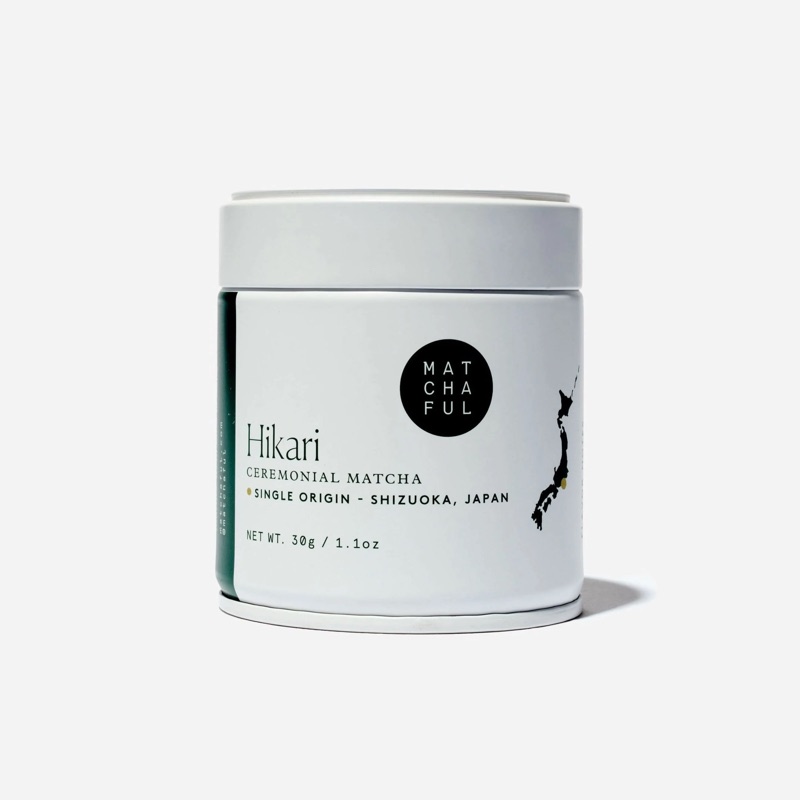
Single-farm matcha from Shizuoka with a 2026 lab report: lead 76 or 114 ppb by two methods, about 0.15 to 0.23 µg per 2 g serving. Not in the USDA organic listing. Best value in the 100 g bag; only sister Kiwami was tested outside.
Best for Latte and smoothie drinkers who want a named farm and a readable lab report at a lower price than Kiwami, and who do not need an organic seal.
- Our quality rating
- Fair (3 of 5)
- Price range
- Mid-range
- Size
- 30 g tin, 100 g bag or 1 kg bag
- Made in
- Hattori Tea Farm, Shizuoka, Japan, as stated by the maker
approx. $42 for a 30 g tin ($79 for 100 g)
See it on Matchaful’s site →We are not affiliated with Matchaful. This link goes to the maker’s own page, with no tracking code. How we're funded.
Reader ratings & reviews
– out of 5
Loading ratings…
Rating breakdown
- 5 stars 0
- 4 stars 0
- 3 stars 0
- 2 stars 0
- 1 star 0
Have this product? Please rate it.
Check your email
We sent a sign-in link to . Click it and you’ll come straight back here, signed in. It expires in 15 minutes; check your spam folder if it doesn’t show up. Thank you for helping the community!
Your review
Reviews are personal experiences, not research, and they never change our quality ratings. Every review is read by our team before it appears.
How we evaluated it
Why we chose it What put it on our list
- Matchaful posts a 2026 lab report for Hikari (reported 4 Feb 2026): no pesticides detected in two screening panels, radioactive cesium and iodine below detection, cadmium 10 to 19 ppb, arsenic below 10 to 22 ppb.
- The report gives two lead figures for the same sample: 76 ppb by ICP-MS and 114 ppb by a second method. Matchaful’s summary uses 76. Both are on the page, so you can see them.
- It comes from the same farm as Kiwami, where an outside lab found lead 73 ppb in a January 2025 batch. We found no outside test of Hikari itself.
- At $79 for 100 g it works out to about $0.79 a gram, the lowest we found for a matcha with a readable lab report. The page names the farm and prints a Best By date on the package.
Trade-offs What to weigh before you buy
- It is not shown as certified organic. The USDA database lists Matchaful’s Kiwami but not Hikari. The page headline says “pesticide-free”, yet its farm section says “USDA Certified Organic”. Treat it as not certified until Matchaful clears that up.
- It still contains lead. A 2 g serving carries about 0.15 µg at 76 ppb and 0.23 µg at 114 ppb; a 4 g latte serving, the size Matchaful suggests, about 0.30 µg and 0.46 µg. California’s Prop 65 safe-harbor level for lead is 0.5 µg a day, so one 4 g serving at the higher figure comes close to it and a second would exceed it. FDA’s interim reference levels for lead from all food are 2.2 µg a day for children and 8.8 µg a day for women of childbearing age.
- The lab’s name is blacked out in Matchaful’s PDF, so the report is the maker’s own.
- Matchaful describes it as a go-to for lattes and smoothies. Use the cheaper 100 g bag only if you will finish it within a month of opening.
What to know Details worth knowing first
Hikari is the cheaper of Matchaful’s two matchas that publish lab reports. It comes from the same Shizuoka farm as Kiwami and is sold for lattes and smoothies. We list it with a lower score than Kiwami for three reasons: it is not shown as organic, its report gives two different lead numbers, and no outside lab has tested it.
Matcha is the one tea where you drink the whole leaf, so the lead in the leaf is all in the cup (see our matcha guide). Every matcha we found with an outside lab result had lead in it. Hikari’s own report puts it in the same range, between 76 and 114 ppb depending on the method. That works out to roughly 0.15 to 0.23 µg of lead in a 2 g bowl and 0.30 to 0.46 µg in a 4 g latte. California’s Prop 65 safe-harbor level for lead is 0.5 µg a day, so a 4 g latte at the higher figure uses most of it.
If you want the organic seal, choose Kiwami. If you want to avoid drinking the leaf, choose a steeped tea. Our lead guide explains why we do not call any amount of lead safe.
Quality & testing How it measures up against our checklist
- Third-party tested
- No
- Tested by
- Not named (blacked out in the PDF)
- Certificate of analysis
- Yes
| What we checked | What we found |
|---|---|
| Tested for lead and pesticides Maker’s claim | Matchaful’s 2026 report: lead 114 ppb (first method) and 76 ppb (ICP-MS), cadmium 18.9 and 10, arsenic 22.0 and below 10, mercury below 5; pesticide panels not detected at the limit of quantitation; cesium below 1 Bq/kg. No outside test of Hikari found. |
| Organic Not verified | Not confirmed. The USDA Organic Integrity Database lists Matchaful’s Kiwami, Houjicha and other powders but not Hikari. Matchaful’s page is inconsistent: “pesticide-free” in the headline, “USDA Certified Organic” in the farm section. |
| Named origin Maker’s claim | Hattori Tea Farm, Shizuoka, Japan, a single estate, first-harvest leaves. This comes from Matchaful’s page. |
| Loose leaf or plastic-free bags Maker’s claim | A powder, not a tea bag, sold in a 30 g tin or in 100 g and 1 kg bags. The pages do not say what the bags are made of. |
| Freshness Maker’s claim | Matchaful says it is ground to order, prints a Best By date on the package and advises using an opened container within a month. No harvest year is stated. |
| Notices and recalls Verified | We found no California Prop 65 notices and no FDA recalls naming Matchaful when we searched on 22 Oct 2026. |
What the labels mean
- Verified We opened an independent record that confirms it: a certifier’s listing, a regulator’s list or a lab report. It is linked under Sources.
- Maker’s claim The maker says so on its own page or label. We read it but found no independent record.
- Not verified We looked and could not confirm it, or the maker does not say. Treat it as unknown.
Sources Where our facts come from
- Matchaful: Hikari Single Origin Matcha (product page). Maker’s page. Open ↗
- Matchaful: lab test results for our tea products (June 2026). Maker’s page. Open ↗
- Matchaful: Hikari lab report 2026 (PDF). Maker’s page. Reported 4 Feb 2026. The lab’s name is blacked out. The two lead figures come from two methods in the same report. Open ↗
- USDA Organic Integrity Database: Matchaful, Inc dba Matchaful. Certifier or regulator listing. Lists Kiwami and other powders; Hikari does not appear. Open ↗
- Lead Safe Mama: lab test of Matchaful Kiwami Super Ceremonial Matcha (2025). Test report. A community-funded test by an advocacy group, run at SGS North America, of the sister product from the same farm. It is not a test of Hikari. Open ↗
- California Attorney General: Prop 65 60-day notice search. Certifier or regulator listing. Searched by alleged violator on 22 Oct 2026; no notice named Matchaful. Open ↗
- FDA: lead in food and foodwares (interim reference levels). Independent source. Open ↗
- OEHHA: Prop 65 guideline stating lead’s safe-harbor levels (0.5 µg/day reproductive, 15 µg/day cancer). Independent source. Interpretive Guideline 2011-001, published by OEHHA. The 0.5 µg/day figure is also listed in California Code of Regulations, title 27, section 25805(b). Open ↗
- California Code of Regulations, title 27, § 25805: levels for chemicals causing reproductive toxicity (lead: 0.5 µg/day). Independent source. Open ↗
Alternatives Other options to compare
- Matchaful Organic Kiwami Single Cultivar Matcha Same farm and same lab approach, listed as organic by the USDA database and checked by an outside lab. $49 for 30 g, $98 for 100 g.
- Matchaful Houjicha Roasted green tea powder, listed as organic, with less lead in Matchaful’s report (about 45 to 50 ppb) and a lower price. It is not matcha.
- A steeped loose-leaf tea You drink the infusion rather than the whole leaf, and it costs far less per cup.