Products · Honey & natural sweeteners · New Zealand Honey Co.
New Zealand Honey Co. Raw Manuka Honey UMF 10+ (MGO 263+), 17.6 oz
Reader ratings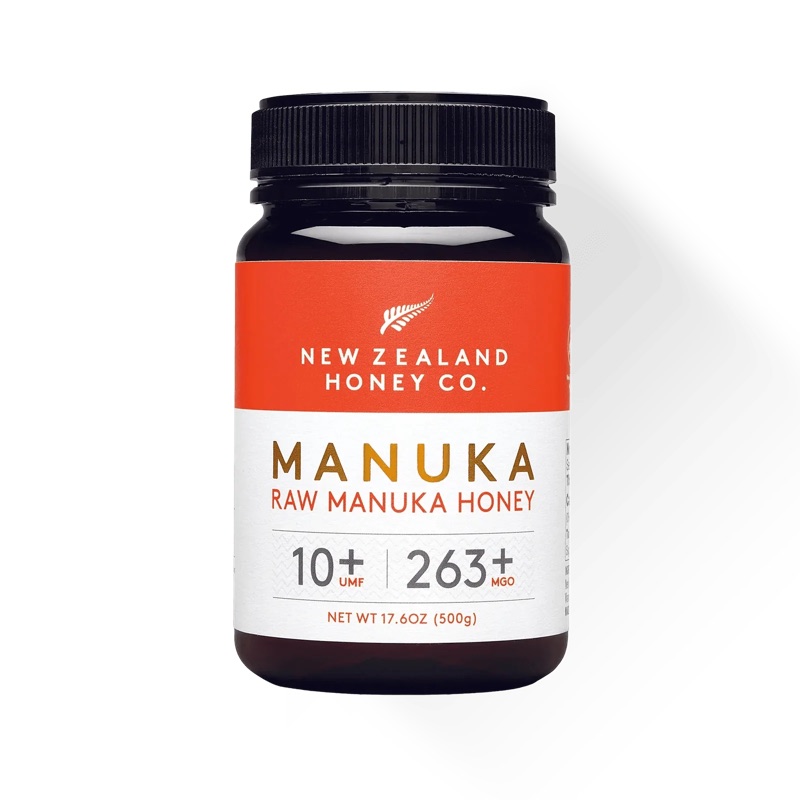
The cheapest licensed manuka here, about $1.64 an ounce. ConsumerLab tested this maker’s 15+ and 20+ but not this grade, so its evidence is a UMF lot certificate and two listings, none from an independent lab. Plastic jar.
Best for Readers who want a UMF-graded manuka for everyday use at the lowest price here, and who accept that no independent lab has tested this grade.
- Our rating
- Fair (3.0 of 5)
- Price range
- Mid-range
- Verified marks
- Licensed by the Unique Manuka Factor Honey Association (licence 2060), listed on the association’s own site, Listed by the Detox Project as Glyphosate Residue Free
- Size
- 17.6 oz (500 g) jar made of recycled PET plastic
- Made in
- New Zealand, from remote hive sites across the country; each lot’s certificate page shows a map pin for its hives
approx. $28.88 for 17.6 oz (500 g); the 8.8 oz jar is $18.88
See it on New Zealand Honey Co.’s site → (opens in a new tab)We are not affiliated with New Zealand Honey Co.. This link goes to the maker’s own page, with no tracking code. How we're funded.
Also sold at Amazon ($29 for 17.6 oz ($28.88), the same as the maker’s price), Walmart ($29 for 17.6 oz ($28.88)) .
Reader ratings & reviews
– out of 5
Loading ratings…
Rating breakdown
- 5 stars 0
- 4 stars 0
- 3 stars 0
- 2 stars 0
- 1 star 0
Have this product? Please rate it.
Check your email
We sent a sign-in link to . Click it and you’ll come straight back here, signed in. It expires in 15 minutes; check your spam folder if it doesn’t show up. Thank you for helping the community!
Your review
Reviews are personal experiences, not research, and they never change our quality ratings. Every review is read by our team before it appears.
How we evaluated it
How it scores Our rating, metric by metric
- Real and unblended 25% of the rating 3 of 5
A licensed UMF grade with a lot report on the association’s own server, but no independent lab has tested this grade and no NMR or isotope result is posted.
- Independent testing 30% of the rating 3 of 5
The Detox Project lists it for glyphosate and the lot report sits on the certifier’s server, but no independent lab has tested this grade for heavy metals and we found no published antibiotic result.
- Sourcing 15% of the rating 3 of 5
Each lot’s certificate shows a hive map pin and the maker says unpasteurised, but it names no apiary or beekeeper, says its honey is creamed and gives no heating temperature or filtering.
- Packaging 10% of the rating 2 of 5
A recycled PET plastic jar with a polypropylene lid, and no glass option.
- Trust 10% of the rating 3 of 5
No recall, Prop 65 notice or lawsuit found and its lot report matches the certifier’s record, but its “Certified Free of Herbicides” badge goes past a glyphosate-only listing, its FAQ claims treatment of skin conditions, and it pays affiliates 10%.
- Value 10% of the rating 4 of 5
About $1.64 an ounce in the large jar, the cheapest manuka here and the lowest cost per milligram of label MGO, though ConsumerLab says manuka costs 6 to 25 times as much as other honey.
The rating, 3.0 of 5, is the weighted average of these scores. See how we rank honey & natural sweeteners and our standard.
Where to buy Stores and the prices we saw
- Amazon (opens in a new tab) approx. $29 for 17.6 oz ($28.88), the same as the maker’s price. Sold by New Zealand Honey Co, the brand’s own storefront, and shipped by Amazon. In stock on 2026-11-03.
- Walmart (opens in a new tab) approx. $29 for 17.6 oz ($28.88). Sold by New Zealand Honey Co on Walmart’s marketplace and delivered by Walmart. In stock on 2026-11-03.
Prices as we saw them on November 3, 2026. They change often. These links carry no tracking code and earn us nothing.
What’s in it Every ingredient, in label order
- Raw monofloral manuka honey (New Zealand)
Who tested it What each test found, and who paid for it
- Paid certification Hill Laboratories, for the maker as UMF licensee: certificate for lot 610210 March 2026
UMF 10+ lot reported 2026-03-03: UMF grade 10.2, MGO 272 mg/kg, leptosperin 250, DHA 552, HMF 17.1. The UMF association’s own certificate page shows the same figures as the maker’s lot page. Open ↗ (opens in a new tab)
- Paid certification The Detox Project (certification the maker pays for) November 2026
Lists this grade among its Glyphosate Residue Free certified products. The Detox Project’s standard asks for no glyphosate down to the usual detection limit (0.01 ppm), tested at least twice a year plus spot checks, paid for by the brand, and says spot-check results stay confidential. The maker says every batch is also tested by Analytica Laboratories. No result is posted. Open ↗ (opens in a new tab)
- Paid certification Unique Manuka Factor Honey Association (a licence the maker holds and pays for) November 2026
Licence 2060 is listed for New Zealand Honey Co. Ltd. The association says a UMF grade tests potency (MGO), authenticity (leptosperin), shelf life (DHA) and freshness (HMF). Open ↗ (opens in a new tab)
- Independent ConsumerLab (member-funded; it bought the honey on the open market, and it also runs a separate voluntary certification program that companies pay for, which does not list this maker). It tested this maker’s 15+ and 20+, not the 10+ May 2025
Bought eight manuka honeys, including this maker’s UMF 15+ and 20+, and had MPI-recognised labs test them without knowing the brands. Its free pages say all eight were authentic by DNA and chemical analysis and none was contaminated with heavy metals such as lead. This grade was not among them, so these results do not cover it. Open ↗ (opens in a new tab)
Who paid, and why it matters
- Independent The tester took no money from the maker for it: a consumer group, a journalist, a university or a regulator.
- Paid certification An outside lab or certifier tested or listed it, and the maker paid for that.
- Maker’s own test A lab report or certificate of analysis the maker commissioned and published.
A certification is a floor, not a verdict: it checks what its program checks and nothing else. We weigh tests by someone with no stake in the result most.
What people ask Worries raised online and elsewhere, and what we found
- Is it real manuka, or a blend with something cheaper?
- Licence 2060 is on the UMF association’s list (opens in a new tab) and the association’s certificate page (opens in a new tab) for a 10+ lot matches the maker’s lot page, but no independent lab has tested this grade. ConsumerLab’s test (opens in a new tab) found the maker’s 15+ and 20+ authentic. The UMF association tested 46 manuka brands packed outside New Zealand and sold in the UK and US and says all failed (opens in a new tab) New Zealand’s definition, but that is the industry body’s own test. This honey is packed in New Zealand. None of these is an NMR or isotope test for added syrup.
- Does it contain glyphosate?
- The Detox Project lists this grade (opens in a new tab) as Glyphosate Residue Free, and the maker says it tests every batch. We could not find a published result, and ConsumerLab did not test for it. The lot page calls the honey “Certified Free of Herbicides”, which goes further than a glyphosate-only listing. See our guide to glyphosate and health.
- Does it contain lead or other heavy metals?
- We could not confirm it for this grade. ConsumerLab’s 2025 test (opens in a new tab) found no heavy metal contamination in any of its eight honeys, including the maker’s 15+ and 20+, but it did not test the 10+.
- Is a mild grade like 10+ worth buying?
- Our pages on manuka honey’s evidence and its clinical studies find mostly lab work and small studies, and ConsumerLab says clinical research is limited. We found no study showing a stronger grade does more when eaten, so a mild grade is a fair choice for the table. For wounds, our pages point to sterile medical-grade dressings under a clinician, not a food jar, though this lot page’s FAQ says the honey “can aid in wound healing”.
- Is it really raw, or heated and creamed?
- The maker says it is 100% raw and not pasteurised (product page (opens in a new tab)), and the certificate page for this grade (opens in a new tab) says “Our honey is creamed”, with no temperature given. A rival maker, Steens (opens in a new tab), says most manuka sold as raw is heated to about 66 C and creamed, and names no brands. We could not confirm either way.
- Are the glowing reviews and Top Pick claims paid for?
- The maker runs an affiliate and partners program (opens in a new tab) that pays 10% of each referred sale and supplies ready-made social posts, so some online “best manuka” lists may carry its links. We take no payment from any brand. The ConsumerLab recognition the maker advertises is for its 15+ and 20+, not this grade.
- Has the maker had recalls, Prop 65 notices or lawsuits?
- None found. The openFDA recall search (opens in a new tab) has no match, and California’s Prop 65 search shows no notice naming this maker: “Honey” in the violator’s name (opens in a new tab) gives 63 notices and “manuka” in the product (opens in a new tab) gives 3, none its own. A web search found no lawsuit or warning letter. We could not search Reddit.
Why we chose it What put it on our list
- The grade can be checked. The maker’s UMF licence, number 2060, is on the Unique Manuka Factor Honey Association’s own list of licensed brands, and the association says a UMF grade tests MGO, leptosperin, DHA and HMF.
- A 10+ lot certificate is public and matches the certifier’s record. Lot 610210, tested by Hill Laboratories and reported 2026-03-03, is on the UMF association’s own certificate server with UMF 10.2, MGO 272 mg/kg against the 263 on the label, leptosperin 250 and HMF (the freshness marker) of 17.1 mg/kg, under the 40 mg/kg ConsumerLab allows in fresh manuka. The maker’s index lists at least 28 lots of this grade.
- The same maker’s 15+ and 20+ were found authentic with no heavy metals in an independent test. In 2025 ConsumerLab bought eight manuka honeys on the open market, including those two, and found all eight authentic with no heavy metal contamination. It did not buy the 10+.
- It is the cheapest manuka here. The large jar costs about $1.64 an ounce, and 20 mg of label MGO costs about $4.40 against about $6 in the 15+ and 20+ (our arithmetic from the label figures).
- Glyphosate is covered by a third-party listing. The Detox Project’s Glyphosate Residue Free list names this grade, and the maker says it also tests every batch. One ingredient: raw monofloral manuka honey.
Trade-offs What to weigh before you buy
- No independent lab has published a result for this grade. ConsumerLab bought the maker’s 15+ and 20+, not the 10+, so its findings on authenticity and heavy metals do not cover this jar. The lot certificate is the maker’s lab report, hosted by the UMF association, and the Detox Project and UMF listings are paid for by the maker, so testing and authenticity score lower than for the 15+ and 20+.
- The jar is recycled PET plastic with a polypropylene lid, and the maker offers no glass jar. We found no test of what the plastic gives off, so packaging scores low.
- At 10+ the MGO is modest, which is why it costs less. Our manuka pages note that most of the evidence is from the lab or from small studies, so a stronger grade is not shown to do more when eaten.
- ConsumerLab’s independent test covered authenticity and heavy metals, not glyphosate or antibiotics, and we found no published antibiotic result.
- The maker names no apiary or beekeeper and says only that the honey comes from remote hives across New Zealand. It says the honey is raw and unpasteurised, but this grade’s certificate page also says “Our honey is creamed”, and it gives no heating temperature or filtering.
- The lot page carries a “Certified Free of Herbicides” badge, but the Detox Project listing covers glyphosate only, and its FAQ says manuka honey “can aid in wound healing” and “treat skin conditions”, which our pages on the evidence do not support.
- Like any honey it is added sugar, and it is not for babies under 12 months.
What to know Details worth knowing first
If you want licensed manuka without the premium price, this is the entry point, with a plain caveat: no independent lab has tested this grade. The maker’s licence, number 2060, is on the Unique Manuka Factor Honey Association’s own list, and the association’s certificate server holds a Hill Laboratories report for a 10+ lot that shows the grade and marker numbers the label promises.
It has less independent backing than the maker’s stronger grades. ConsumerLab tested the 15+ and 20+ in 2025 and found them real manuka with no heavy metal contamination, but it did not buy the 10+. That is why this jar scores lower on testing, and why we say so plainly.
At about $1.64 an ounce in the large jar it is the cheapest manuka we list, and it comes in recycled plastic, not glass. Our manuka honey evidence page explains why a mild grade is a fair choice for eating.
What we checked Each claim, and how sure we are of it
| What we checked | What we found |
|---|---|
| One ingredient Maker’s claim | The maker lists raw New Zealand monofloral manuka honey and nothing else. |
| Licensed UMF grade Verified | Licence 2060 is listed for New Zealand Honey Co. Ltd on the UMF association’s own site. |
| Lot certificates Verified | A 10+ lot (610210) read on the UMF association’s certificate server matches the grade, MGO and leptosperin numbers on the maker’s lot page. The index lists at least 28 lots of this grade; we did not open them all. |
| Authenticity test (NMR or isotope) Maker’s claim | The lot certificate shows the UMF grade and marker levels; the maker says each batch also gets a C4 sugar test. We saw no C4 or NMR result, and no independent lab tested this grade. |
| Glyphosate Verified | Listed as Glyphosate Residue Free by the Detox Project, a listing the brand pays for. It covers glyphosate only, and no residue results are published. |
| Lead and heavy metals Not verified | Not tested independently for this grade. ConsumerLab found none in the maker’s 15+ and 20+. |
| Antibiotics and other pesticides Not verified | Not stated. We found no published result. |
| Named source, raw, filtering Maker’s claim | New Zealand, with the lot’s hive map pin behind a QR code. Raw and unpasteurised per the maker, which also says its honey is creamed; filtering and heating temperature are not stated. |
| Glass or metal packaging Maker’s claim | No. The jar is recycled PET plastic and the lid is polypropylene. |
What the labels mean
- Verified We opened an independent record that confirms it: a certifier’s listing, a regulator’s list or a lab report. It is linked under Sources.
- Maker’s claim The maker says so on its own page or label. We read it but found no independent record.
- Not verified We looked and could not confirm it, or the maker does not say. Treat it as unknown.
Sources Where our facts come from
- New Zealand Honey Co.: Manuka Honey UMF 10+ MGO 263+ product page. Maker’s page. $18.88 for 8.8 oz and $28.88 for 17.6 oz on 2026-11-03; ingredients, RPET jar, raw claim and glyphosate claim. Open ↗ (opens in a new tab)
- New Zealand Honey Co.: credentials and testing partners. Maker’s page. Says Analytica Laboratories tests each batch (MPI manuka tests, colour, moisture, tutin, AFB, leptosperin and C4 sugars) and Hill Laboratories does the MPI and standard honey tests; polypropylene lids. A maker claim. Open ↗ (opens in a new tab)
- New Zealand Honey Co.: lot 610210 certificate. Test report. UMF 10+ lot, Hill Labs: UMF grade 10.2, MGO 272 mg/kg, leptosperin 250, with a hive map pin. Published by the maker; its text says “Our honey is creamed” and carries the “Certified Free of Herbicides” badge. Open ↗ (opens in a new tab)
- UMF Honey Association: certificate U1000014494 (lot 610210). Certifier or regulator listing. The association’s own record: licensee New Zealand Honey Co. Limited, licence 2060, Hill Labs, reported 2026-03-03, UMF 10.20, leptosperin 250, DHA 552, MGO 272, HMF 17.1. This host did not resolve from our network; opened through a public DNS server. Open ↗ (opens in a new tab)
- UMF Honey Association: New Zealand Honey Co. licence 2060. Certifier or regulator listing. The association’s own licensee page, opened directly on 2026-11-03. Open ↗ (opens in a new tab)
- UMF Honey Association: the four-factor quality test. Independent source. MGO for potency, leptosperin for authenticity, DHA for shelf life and HMF for freshness. Open ↗ (opens in a new tab)
- UMF Honey Association: certification search by licence and batch number. Certifier or regulator listing. Lets a buyer trace a jar’s batch number to its test results. Open ↗ (opens in a new tab)
- New Zealand Honey Co.: index of UMF lot certificates. Maker’s page. 47 pages of lot certificates on 2026-11-03, six a page; at least 28 are labelled UMF 10+. Open ↗ (opens in a new tab)
- The Detox Project: Glyphosate Residue Free certified products. Certifier or regulator listing. Lists New Zealand Honey Co. Manuka Honey UMF 5+ through UMF 30+, including UMF 10+ MGO 263+. Opened through a public DNS server. Open ↗ (opens in a new tab)
- The Detox Project: Glyphosate Residue Free certification standard. Independent source. Glyphosate only, no residue down to the usual detection limit (0.01 ppm); the brand pays a yearly fee and the lab tests, at least two tests a year plus spot checks; spot-check results stay confidential. Open ↗ (opens in a new tab)
- ConsumerLab: Best and worst manuka honeys (May 2025). Test report. Free summary naming the eight honeys, including this maker’s UMF 15+ and 20+ but not its 10+. The full results are for members. Open ↗ (opens in a new tab)
- ConsumerLab: how the manuka honeys were evaluated. Test report. Open-market purchases, MPI-recognised labs, blinded samples, limits for MGO, UMF, HMF and for lead, arsenic, cadmium and mercury. It does not say how many lots of each product were tested. Open ↗ (opens in a new tab)
- ConsumerLab: Manuka honey review page. Test report. Lists the eight products compared and says none were contaminated with heavy metals such as lead. It also says clinical research on manuka honey is limited and that manuka costs 6 to 25 times as much as other honey. Open ↗ (opens in a new tab)
- ConsumerLab: New Zealand Honey Co. brand page. Test report. Says two of the maker’s products were tested and reviewed (the 15+ and 20+); the counts of approved products and Top Picks are hidden for non-members. Open ↗ (opens in a new tab)
- FoodNavigator: Manuka honey claims dismissed in UK and US (2023). Test report. The UMF association’s test of 46 non-New Zealand manuka brands; the association is an industry body. Open ↗ (opens in a new tab)
- New Zealand Honey Co.: affiliate and partners program. Maker’s page. Offers 10% commission on referred sales within 30 days and ready-made social posts. Open ↗ (opens in a new tab)
- Steens: raw and unpasteurised honey. Independent source. A competitor’s claim that most manuka sold as raw is heated and creamed. Open ↗ (opens in a new tab)
- Amazon: Raw Manuka Honey UMF 10+ MGO 263+, 17.6 oz. Independent source. $28.88 on 2026-11-03, sold by New Zealand Honey Co and shipped by Amazon. Open ↗ (opens in a new tab)
- Walmart: New Zealand Honey Co. Raw Manuka Honey UMF 10+ MGO 263+, 17.6 oz. Independent source. $28.88 on 2026-11-03, sold by New Zealand Honey Co and delivered by Walmart. Open ↗ (opens in a new tab)
- openFDA food enforcement reports: recalling firm New Zealand Honey. Certifier or regulator listing. Searched 2026-11-03: no matches. Open ↗ (opens in a new tab)
- California Attorney General: Prop 65 60-day notice search for “Honey”. Certifier or regulator listing. Searched 2026-11-03: 63 notices with “Honey” in the alleged violator’s name; none is New Zealand Honey Co. Open ↗ (opens in a new tab)
- California Attorney General: Prop 65 60-day notice search for product “manuka”. Certifier or regulator listing. Searched 2026-11-03: 3 notices, for a mask and olives made by other companies. Open ↗ (opens in a new tab)
Alternatives Other options to compare
- New Zealand Honey Co. UMF 15+ (MGO 514+), 8.8 oz A stronger grade at about $4.42 an ounce. ConsumerLab tested it, and the maker says it was the Top Pick.
- New Zealand Honey Co. UMF 20+ (MGO 829+), 8.8 oz The strongest grade here at about $7.26 an ounce. ConsumerLab tested it too.