Products · Tea & teaware · Numi
Numi Organic Chinese Breakfast Black Tea (tea bags)
Reader ratings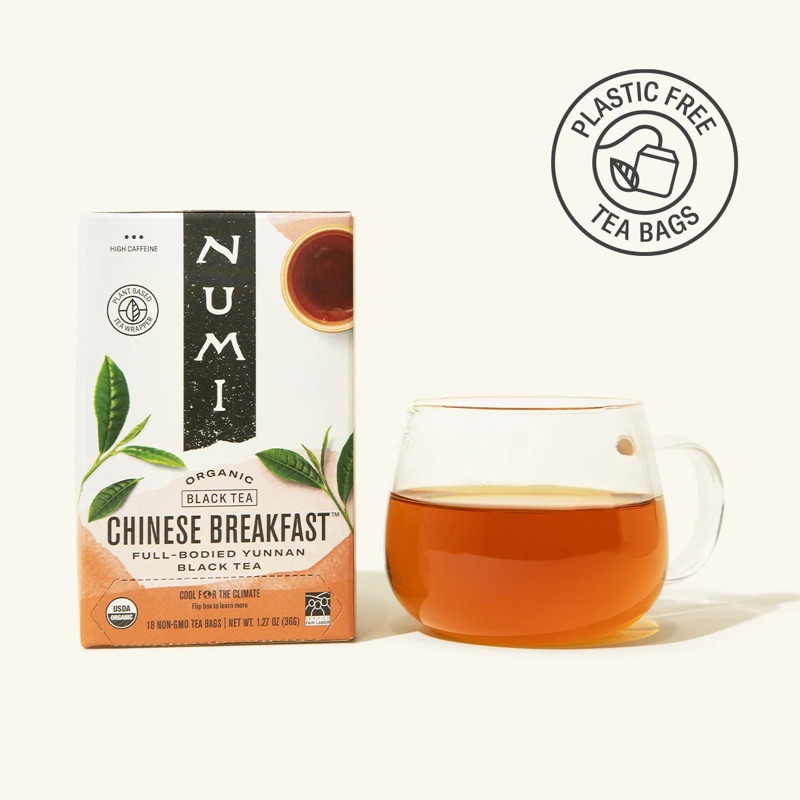
Plain organic Yunnan black tea in bags the maker says are manila hemp, not plastic. Organic status is verified, but the bag claim and the lab testing rest on Numi’s word, and Numi shows no test results.
Best for People who prefer tea bags and want a plastic-free bag at a low price, and who accept maker-only evidence.
- Our quality rating
- Fair (3 of 5)
- Price range
- Budget
- Verified marks
- USDA Organic (QAI)
- Size
- 18 tea bags per box (also 100 bags packed loose in a carton)
- Made in
- Yunnan, China, as stated on the page
approx. $7.99 for 18 tea bags
See it on Numi’s site →We are not affiliated with Numi. This link goes to the maker’s own page, with no tracking code. How we're funded.
Reader ratings & reviews
– out of 5
Loading ratings…
Rating breakdown
- 5 stars 0
- 4 stars 0
- 3 stars 0
- 2 stars 0
- 1 star 0
Have this product? Please rate it.
Check your email
We sent a sign-in link to . Click it and you’ll come straight back here, signed in. It expires in 15 minutes; check your spam folder if it doesn’t show up. Thank you for helping the community!
Your review
Reviews are personal experiences, not research, and they never change our quality ratings. Every review is read by our team before it appears.
How we evaluated it
Why we chose it What put it on our list
- Numi says its tea bags are compostable and made from manila hemp cellulose, unbleached, with cotton string and a tag made from recycled materials. That description names no nylon, PET or other plastic.
- The USDA Organic Integrity Database lists Numi Inc, PBC (certifier QAI) with “Chinese Breakfast Tea” among its certified products.
- The page names a region, Yunnan, and lists one ingredient: organic Yunnan black tea.
- Numi says it requires laboratory testing for all its teas and a certificate of analysis with each purchase. The price is about $0.44 a bag, or about $0.35 a bag in the 100-bag carton ($34.99).
Trade-offs What to weigh before you buy
- Numi publishes no test results. The lab-testing claim is the maker’s, and we found no outside test of any Numi tea.
- The bag claim is also the maker’s. Numi does not say how the bag seam is closed, and we found no outside test of its bags for microplastics.
- A 2016 California Prop 65 notice alleged lead in Numi’s “dried teas (loose leaf and bagged)”. It is an allegation, and we found no later notice.
- The outer wrapper is lined with sugarcane-based PLA and a metalized layer. It is commercially compostable, not recyclable, and it does not go in the cup. The page gives no harvest date.
What to know Details worth knowing first
Some tea bags are made of nylon or PET, and lab tests have found they shed billions of plastic particles into hot water (see loose leaf vs. tea bags). Whether that harms people is not established, so avoiding them is a precaution. If you want bags, the choice is paper or plant fiber, and the maker’s description of the material is the main evidence you get.
Numi’s description is specific: manila hemp cellulose, unbleached, cotton string. That is why this is the bagged tea we list, and why it gets a 3 and not a 4. We could not check the bag claim or the lab-testing claim independently, and Numi shows no results. The organic listing is the one thing the USDA database confirms.
If you can use loose leaf, you avoid the question. Our guide to cutting microplastic exposure covers other places plastic meets hot food and drink.
Quality & testing How it measures up against our checklist
- Third-party tested
- No
| What we checked | What we found |
|---|---|
| Tested for lead and pesticides Maker’s claim | Numi says it requires laboratory testing for all its teas and a certificate of analysis with each purchase. No results are published. |
| Organic Verified | Numi Inc, PBC (Oakland, California; NOP ID 5520030410) is certified by QAI under the USDA National Organic Program. The listing includes “Chinese Breakfast Tea”. |
| Named origin Maker’s claim | Yunnan, China, from Numi’s page. |
| Loose leaf or plastic-free bags Maker’s claim | Numi’s FAQ says the bags are compostable, made from manila hemp cellulose, unbleached, with cotton string. It does not say how the bag is sealed. |
| Freshness Not verified | No harvest date or best-by date on the page. |
| Notices and recalls Verified | One 2016 Prop 65 notice named Numi, Inc. for lead in dried teas (loose leaf and bagged). We found no FDA recalls and no later notice when we searched on 22 Oct 2026. |
What the labels mean
- Verified We opened an independent record that confirms it: a certifier’s listing, a regulator’s list or a lab report. It is linked under Sources.
- Maker’s claim The maker says so on its own page or label. We read it but found no independent record.
- Not verified We looked and could not confirm it, or the maker does not say. Treat it as unknown.
Sources Where our facts come from
- Numi: Chinese Breakfast (product page). Maker’s page. Open ↗
- Numi: frequently asked questions. Maker’s page. Source for the tea bag material, wrapper and laboratory-testing statements. Open ↗
- USDA Organic Integrity Database: Numi Inc, PBC. Certifier or regulator listing. Open ↗
- California Attorney General: Prop 65 60-day notice search. Certifier or regulator listing. Searched by alleged violator on 22 Oct 2026; one 2016 notice (AG number 2016-00890) named Numi. Open ↗
Alternatives Other options to compare
- The Tao of Tea Organic Genmaicha (loose leaf) No bag at all, and an outside lab found no lead in a strong brew of it.
- Harney & Sons Organic Green Premium Teabags Harney’s statement (2019) says its paper tea bags have no PET, PLA, glue or staples. Its “sachets” are a different product, which that statement calls nylon. $9 for 20 bags; the page names no origin beyond “Chinese green teas”.