Products · Building a sauna · ROCKWOOL
ROCKWOOL Comfortbatt Stone Wool Insulation, R-15, 3.5 in
Reader ratings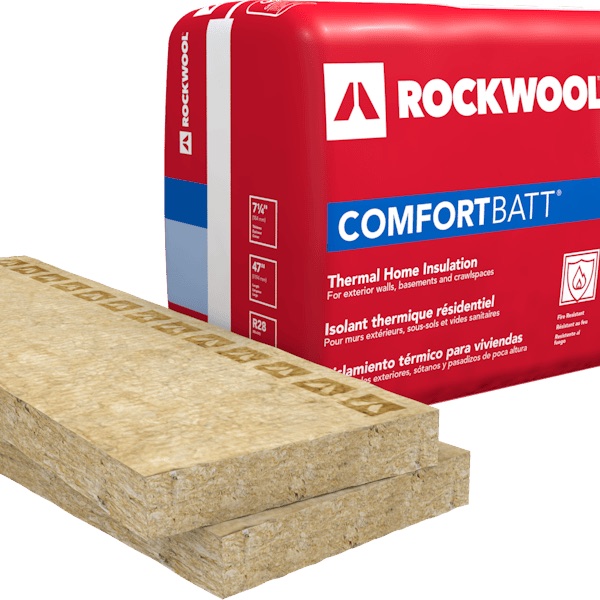
Non-combustible stone wool batts, GREENGUARD Gold certified per ROCKWOOL, with flame-spread and smoke ratings of 0. ROCKWOOL labels them “Red List Approved”, not formaldehyde-free; its AFB evo is the formaldehyde-free version.
Best for Builders insulating the walls and ceiling of a home sauna who want a non-combustible, rot-proof insulation and accept a binder in the batt.
- Our rating
- Good (4.2 of 5)
- Price range
- Mid-range
- Size
- R-15 stone wool batts, 3.5 in thick, 15.25 in wide and 47 in long (the 16 in on center wood stud size), 12 batts and 59.7 sq ft per bag, model RXCB351525
- Made in
- ROCKWOOL North America (factories in Mississippi, West Virginia, Washington, Ontario and British Columbia; its page does not say which one makes Comfortbatt)
approx. $85 for a bag of 12 batts covering 59.7 sq ft (about $1.42 per sq ft), as seen at Boulevard Hardware & Supply and Super Arbor on 2026-10-23
See it on ROCKWOOL’s site → (opens in a new tab)We are not affiliated with ROCKWOOL. This link goes to the maker’s own page, with no tracking code. How we're funded.
Also sold at Super Arbor ($85.00 per bag of 12 batts (59.7 sq ft), shipping extra), Boulevard Hardware & Supply ($84.99 per bag), Capitol City Lumber .
Reader ratings & reviews
– out of 5
Loading ratings…
Rating breakdown
- 5 stars 0
- 4 stars 0
- 3 stars 0
- 2 stars 0
- 1 star 0
Have this product? Please rate it.
Check your email
We sent a sign-in link to . Click it and you’ll come straight back here, signed in. It expires in 15 minutes; check your spam folder if it doesn’t show up. Thank you for helping the community!
Your review
Reviews are personal experiences, not research, and they never change our quality ratings. Every review is read by our team before it appears.
How we evaluated it
How it scores Our rating, metric by metric
- Materials 45% of the rating 4 of 5
Inorganic stone wool that ROCKWOOL lists as GREENGUARD Gold certified, but its Declare label is “Red List Approved”, which allows some red-listed chemicals, and only ROCKWOOL’s AFB evo is labeled formaldehyde-free.
- Durability 20% of the rating 5 of 5
Stone wool does not rot or support mold and keeps its shape; ROCKWOOL’s data sheet reports a passed fungi-resistance test and a water vapor sorption of 0.05 percent by volume.
- Safety 10% of the rating 5 of 5
Non-combustible under ASTM E136, with flame-spread and smoke-developed indexes of 0 under ASTM E84, as reported by the maker; the lab is not named.
- Trust 10% of the rating 4 of 5
A large maker that publishes data sheets, EPDs and Declare labels, with no CPSC recall or Prop 65 notice found, although the Comfortbatt line is made for exterior walls, not saunas.
- Value 15% of the rating 3 of 5
About $1.42 per square foot for R-15 ($84.99 to $85 a bag), more than fiberglass batts but a normal premium for stone wool.
The rating, 4.2 of 5, is the weighted average of these scores. See how we rank building a sauna and our standard.
Where to buy Stores and the prices we saw
- Super Arbor (opens in a new tab) approx. $85.00 per bag of 12 batts (59.7 sq ft), shipping extra. Online building-materials seller. Orders start at $399, so one bag alone will not check out; shipping is calculated at checkout.
- Boulevard Hardware & Supply (opens in a new tab) approx. $84.99 per bag. New Jersey hardware store. Special order with in-store pickup in 2 to 8 days. Its description is machine-written and says 16 in wide, but the model number (RXCB351525) and 59.7 sq ft match.
- Capitol City Lumber (opens in a new tab) Raleigh, North Carolina lumber yard. Lists the R15 12-pack covering 59.7 sq ft but shows no price on the page. Orders come through the Do it Best warehouse in 1 to 2 weeks, with free ship-to-store to Raleigh.
Prices as we saw them on October 23, 2026. They change often. These links carry no tracking code and earn us nothing.
What it’s made of What touches your food, water, skin or air
- Unfaced stone wool batts; ROCKWOOL’s Declare label for Comfortbatt is “Red List Approved”, not “Red List Free”, which it says means the product “may contain some Red List chemicals”. The binder is not named on the product page or data sheet
- No foam, plastic film or foil facing
- Non-combustible (ASTM E136), flame spread index 0 and smoke developed index 0 (ASTM E84), fungi resistance passed (ASTM C1338), per ROCKWOOL’s data sheet
Who tested it What each test found, and who paid for it
- Paid certification UL (GREENGUARD Gold certification, as listed by ROCKWOOL)
ROCKWOOL lists Comfortbatt as UL GREENGUARD Gold certified. The program tests chemical emissions from the product against strict limits at room temperature, and makers pay to join it; we could not open UL’s SPOT database to read the certificate. Open ↗ (opens in a new tab)
- Maker’s own test ROCKWOOL (Comfortbatt data sheet, issued 07-2026) July 2026
Type 1 to ASTM C665; flame spread 0 and smoke developed 0 (ASTM E84); non-combustible (ASTM E136); fungi resistance passed (ASTM C1338); water vapor transmission 42 perm at 3.5 in (ASTM E96). They are the maker’s figures; the lab is not named. Open ↗ (opens in a new tab)
- Maker’s own test ROCKWOOL (Declare label on its product transparency page)
A self-disclosure label from the International Living Future Institute’s Declare program lists Comfortbatt as “Red List Approved”. ROCKWOOL says that means it “may contain some Red List chemicals”; only AFB evo is “Red List Free”. Open ↗ (opens in a new tab)
Who paid, and why it matters
- Independent The tester took no money from the maker for it: a consumer group, a journalist, a university or a regulator.
- Paid certification An outside lab or certifier tested or listed it, and the maker paid for that.
- Maker’s own test A lab report or certificate of analysis the maker commissioned and published.
A certification is a floor, not a verdict: it checks what its program checks and nothing else. We weigh tests by someone with no stake in the result most.
What people ask Worries raised online and elsewhere, and what we found
- Does it contain formaldehyde?
- ROCKWOOL’s product transparency page (opens in a new tab) labels Comfortbatt “Red List Approved”, which it explains “may contain some Red List chemicals”, and labels only AFB evo “Red List Free”, with a binder that has no added formaldehyde and a UL Environment validation. It also says all organic materials emit small amounts of formaldehyde. GreenBuildingAdvisor (opens in a new tab) reported in 2017 that mineral wool makers had used binders containing formaldehyde, and that ROCKWOOL (then Roxul) said heat in manufacturing drives virtually all of it off; that is a company claim. If formaldehyde is your concern, AFB evo, made for interior steel-stud walls, is the cleaner stone wool.
- Do people report an odor?
- A 2013 GreenBuildingAdvisor thread (opens in a new tab) has a reader describing a “catty” odor from Comfortbatt batts that faded. A commenter links such odors to the phenolic formaldehyde binder and says they usually dissipate. It was a forum post, not a test, and we found no test of Comfortbatt at sauna temperatures.
- Is it meant for a sauna?
- ROCKWOOL describes Comfortbatt for exterior wall cavities, floors, basements and attics in wood and steel framing, not for saunas. Its data sheet gives 42 perm at 3.5 in, so it is open to vapor and needs the foil barrier on the hot side. Sauna builders use mineral wool because it is non-combustible. Check the heater and sauna maker’s requirements.
- Is it better than foam or fiberglass behind the walls?
- Mineral wool is inorganic, non-combustible and published to have flame-spread and smoke indexes of 0, and our category guide lists foam boards on the hot side as something to avoid. The cost is higher than fiberglass.
- What does it cost, and where do I buy it?
- ROCKWOOL sells through dealers. We opened Super Arbor ($85.00, with a $399 minimum order) and Boulevard Hardware & Supply ($84.99, special order), and Capitol City Lumber lists it without a price. Home Depot, Lowe’s and Ace Hardware list it too but block automated access, so we could not read their live prices (search snapshots showed about $80 to $85).
Why we chose it What put it on our list
- Stone wool is inorganic and non-combustible, with flame-spread and smoke-developed indexes of 0, per ROCKWOOL’s data sheet.
- ROCKWOOL lists it as UL GREENGUARD Gold certified for low chemical emissions, and publishes EPDs, HPDs and Declare labels.
- It does not rot, support mold or sag, and it is easy to cut with a serrated knife.
Trade-offs What to weigh before you buy
- The Declare label is “Red List Approved”, which allows some red-listed chemicals. Only AFB evo is labeled formaldehyde-free.
- It is sold for exterior wall cavities, not for saunas, and it needs a vapor barrier and proper clearances.
- About $1.42 per square foot, more than fiberglass.
- The big-box listings would not open for us, and the stores we could open are small: one has a $399 minimum order and one is a special order.
What to know Details worth knowing first
Behind a sauna’s wood goes insulation, and the question is what it gives off when hot. Stone wool is spun from rock, so it is inorganic and non-combustible, and ROCKWOOL reports flame-spread and smoke-developed indexes of 0 and a passed fungi-resistance test. It also lists Comfortbatt as UL GREENGUARD Gold certified for low chemical emissions; we could not open UL’s database to read the certificate.
One detail matters for our standard. ROCKWOOL’s own transparency page labels Comfortbatt “Red List Approved”, which it says may contain some Red List chemicals, and labels only its AFB evo “Red List Free”, with a binder that has no added formaldehyde. GreenBuildingAdvisor reported in 2017 that mineral wool makers had used binders containing formaldehyde, and ROCKWOOL says heat in manufacturing drives virtually all of it off. We found no test of Comfortbatt at sauna temperatures, so it belongs behind the foil barrier.
ROCKWOOL sells Comfortbatt for exterior walls, not saunas, and its data sheet gives 42 perm, so it is open to vapor and needs the barrier and the heater’s clearances. Home Depot, Lowe’s and Ace Hardware list it but block our checks, so the stores we list are the ones we could open.
What we checked Each claim, and how sure we are of it
- Tested by
- UL (GREENGUARD Gold certification; certificate not opened)
| What we checked | What we found |
|---|---|
| Mineral wool, not foam Maker’s claim | Unfaced stone wool batts, per ROCKWOOL. No foam, plastic sheet or foil facing. |
| Fire and heat ratings Maker’s claim | Non-combustible (ASTM E136), flame spread 0 and smoke developed 0 (ASTM E84), per ROCKWOOL’s product page and data sheet. The lab is not named. |
| Emissions and ingredients Maker’s claim | UL GREENGUARD Gold certified, as listed by ROCKWOOL. Declare label “Red List Approved” (not “Red List Free”); AFB evo is the formaldehyde-free version, validated by UL Environment. We could not open UL’s database. |
| Made for saunas Maker’s claim | ROCKWOOL describes Comfortbatt for exterior wall cavities and does not mention saunas. The data sheet gives 42 perm, so it needs a vapor barrier. |
| Recalls and notices Verified | No recall naming ROCKWOOL in the US Consumer Product Safety Commission data and no Prop 65 notice in the California Attorney General’s search, both on 2026-10-23. |
What the labels mean
- Verified We opened an independent record that confirms it: a certifier’s listing, a regulator’s list or a lab report. It is linked under Sources.
- Maker’s claim The maker says so on its own page or label. We read it but found no independent record.
- Not verified We looked and could not confirm it, or the maker does not say. Treat it as unknown.
Sources Where our facts come from
- ROCKWOOL Comfortbatt: maker’s North America product page. Maker’s page. Certificates, ASTM results and intended applications, seen 2026-10-23. Open ↗ (opens in a new tab)
- ROCKWOOL Comfortbatt thermal insulation data sheet, USA. Maker’s page. Sizes (15.25 x 47 in for 16 in on center), ASTM results, 42 perm; issued 07-2026. Open ↗ (opens in a new tab)
- ROCKWOOL North America: product transparency. Maker’s page. Declare labels (Comfortbatt “Red List Approved”; AFB evo “Red List Free”) and the UL Environment formaldehyde-free validation for AFB evo. Open ↗ (opens in a new tab)
- ROCKWOOL AFB: maker’s North America product page. Maker’s page. AFB and AFB evo, for interior steel-stud partitions. Open ↗ (opens in a new tab)
- GreenBuildingAdvisor: Mineral wool makers dropping formaldehyde binders (2017). Independent source. Mineral wool binders contained formaldehyde; ROCKWOOL’s claim that heat drives virtually all of it off. Open ↗ (opens in a new tab)
- GreenBuildingAdvisor: Odor from Roxul Comfortbatt? (2013 thread). Independent source. A reader’s odor report and a commenter’s answer; forum posts, not tests. Open ↗ (opens in a new tab)
- Super Arbor: Rockwool ComfortBatt 15.25 in. W X 47 in. L R15 unfaced insulation batt, 59.7 sq ft. Independent source. Store price and the $399 order minimum, seen 2026-10-23. Open ↗ (opens in a new tab)
- Boulevard Hardware & Supply: Rockwool ComfortBatt R15 unfaced insulation batt, 59.7 sq ft. Independent source. Store price, model RXCB351525, special order, seen 2026-10-23. Open ↗ (opens in a new tab)
- Capitol City Lumber: Rockwool ComfortBatt stone wool insulation. Independent source. R15 12-pack covering 59.7 sq ft, ordering terms; no price shown (2026-10-23). Open ↗ (opens in a new tab)
- US Consumer Product Safety Commission: recall search. Certifier or regulator listing. Returns no recall for ROCKWOOL (2026-10-23). Open ↗ (opens in a new tab)
- California Attorney General: Proposition 65 60-day notice search for ROCKWOOL. Certifier or regulator listing. No matching records (2026-10-23); searches for Roxul also returned none. Open ↗ (opens in a new tab)
Alternatives Other options to compare
- ROCKWOOL AFB evo (opens in a new tab) The formaldehyde-free stone wool batt, made for interior steel-stud walls and ceilings. Sold through commercial dealers; we found no public price.
- ProSaunas Sauna Foil Radiant and Vapor Barrier A solid aluminum foil barrier for behind the cladding, about $92.90 for 320 sq ft.