Products · Water filters · Waterdrop
Waterdrop G3P600 Tankless Under-Sink Reverse Osmosis System
Reader ratings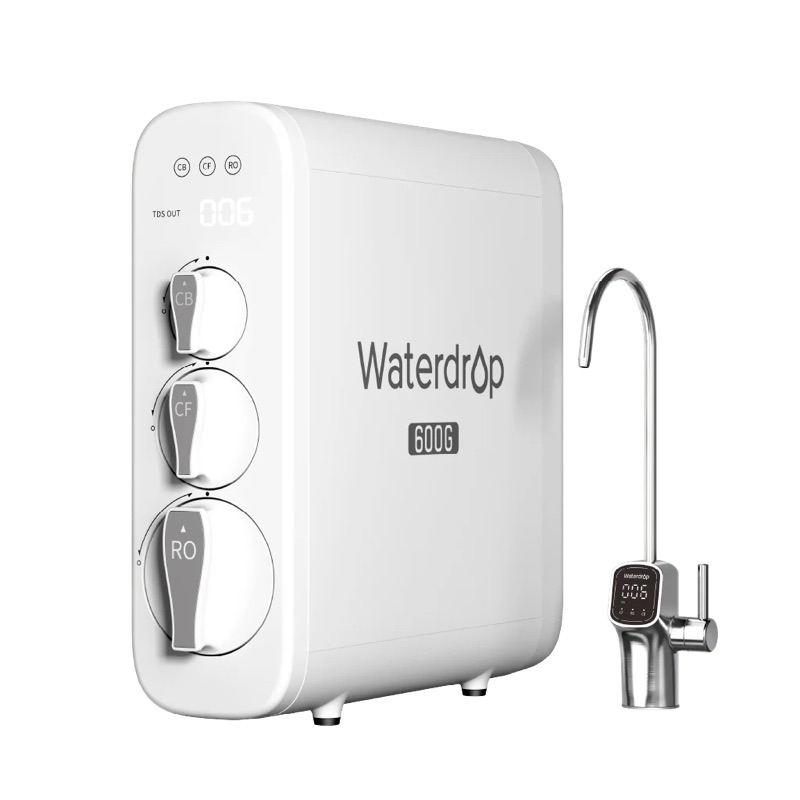
A tankless RO system with lead, fluoride and PFOA/PFOS on IAPMO’s listings, at about $430. Waterdrop’s one-page data sheet shows other claims and no lead or PFAS results, and its page says “NSF Certified” and claims more than the listing.
Best for Anyone who wants a tankless reverse osmosis system for lead, fluoride and PFOA/PFOS at about half the price of the Delta Clarifi and can live with a thin public record.
- Our rating
- Fair (3.4 of 5)
- Price range
- Mid-range
- Verified marks
- IAPMO R&T: NSF/ANSI 58 (lead, fluoride, TDS) and 372, IAPMO R&T, carbon block: NSF/ANSI 53 (PFOA, PFOS), 42
- Size
- Tankless, under-sink, eight stages; rated 600 gallons a day; needs power and a drain connection
- Made in
- Made in China by Qingdao Ecopure Filter Co., Ltd. (per Waterdrop’s data sheet)
approx. $429 (list $539)
See it on Waterdrop’s site → (opens in a new tab)We are not affiliated with Waterdrop. This link goes to the maker’s own page, with no tracking code. How we're funded.
Also sold at Amazon ($429), Walmart ($429) .
Reader ratings & reviews
– out of 5
Loading ratings…
Rating breakdown
- 5 stars 0
- 4 stars 0
- 3 stars 0
- 2 stars 0
- 1 star 0
Have this product? Please rate it.
Check your email
We sent a sign-in link to . Click it and you’ll come straight back here, signed in. It expires in 15 minutes; check your spam folder if it doesn’t show up. Thank you for helping the community!
Your review
Reviews are personal experiences, not research, and they never change our quality ratings. Every review is read by our team before it appears.
How we evaluated it
How it scores Our rating, metric by metric
- Proven reduction 35% of the rating 4 of 5
IAPMO lists lead, fluoride, cadmium, barium, radium and TDS (NSF/ANSI 58) and PFOA/PFOS through the carbon block (53). No nitrate, arsenic, total PFAS or chromium claim, though the page makes some.
- What touches the water 20% of the rating 3 of 5
Plastic cartridges and manifold, a pump and an LED faucet, with the filters listed for material safety and lead-free parts certified. No silver is mentioned, but the plastics and tubing are not named.
- Independent testing 15% of the rating 4 of 5
A paid IAPMO listing covers the key claims, and two independent tests, a lab run and Consumer Reports, covered the sister model G3P800 with mostly good results. No one tested lead or PFAS, and Waterdrop’s own sheet shows another model’s claims.
- Trust 10% of the rating 2 of 5
The page says “NSF Certified” (IAPMO certified it), claims arsenic, chromium and microplastics that the listing lacks, and says it “saves 800% water”. Its data sheet does not match the listing. The affiliate program pays at least 8% and free products.
- Running cost & value 20% of the rating 3 of 5
$429 plus about $145 a year in filters, near $1,150 over five years, about a third less than the Delta Clarifi. Waterdrop’s 2:1 waste ratio has not been measured on this model: a lab run on the sister G3 P800, rated 3:1, got 1.5:1 to 2.2:1.
The rating, 3.4 of 5, is the weighted average of these scores. See how we rank water filters and our standard.
Where to buy Stores and the prices we saw
- Amazon (opens in a new tab) approx. $429. The silver-faucet version, shipped by Amazon and sold by “Waterdrop Filtration Tech”, a seller under the brand’s name. $539 list, shown 20% off on 2026-10-23.
- Walmart (opens in a new tab) approx. $429. Sold and shipped by Ecolife Technologies, Inc., whose Walmart seller page gives the phone number on Waterdrop’s data sheet, so it is Waterdrop’s own account. Free shipping. Home Depot and Lowe’s list the G3P600 only in bundles with an extra filter, so we did not use them.
Prices as we saw them on October 23, 2026. They change often. These links carry no tracking code and earn us nothing.
What it’s made of What touches your food, water, skin or air
- Stage filters: a polypropylene sediment filter (G3-N1CF), a carbon block (G3-N3CB) and a reverse osmosis membrane (G3P600-RO), with an optional mineral filter. IAPMO lists the carbon and polypropylene filters for material safety
- A manifold that routes the water through one integrated plastic channel, an electric pump and a power adapter
- A “smart” faucet with an LED display of TDS readings, in a silver finish; the faucet metal is not stated
- Tubing and fittings: not described. Made in China by Qingdao Ecopure Filter Co., Ltd., which holds the certificates
- No silver or antimicrobial is mentioned. IAPMO also lists the system under NSF/ANSI/CAN 372 for lead content
Who tested it What each test found, and who paid for it
- Paid certification IAPMO R&T
Lists WD-G3P600 (held by the maker Qingdao Ecopure, certificate WC-13976, NSF/ANSI 58-2024, active to 2027-11-21) for TDS, fluoride, cadmium, barium, radium 226/228 and lead, with a daily production rate of 2,715 liters (about 717 gallons). It lists no arsenic, chromium, selenium, nitrate or PFAS claim for the whole system. The maker pays for the program. Open ↗ (opens in a new tab)
- Paid certification IAPMO R&T
Lists the G3 carbon block under NSF/ANSI 53 for PFOA and PFOS (WC-14805) and under 42 for chlorine, taste and odor (WC-14301), rated 1,100 gallons at 0.5 gpm, and the system under NSF/ANSI/CAN 372 for lead content (WC-13977). Open ↗ (opens in a new tab)
- Independent Water Filter Guru, with lab analysis by Tap Score (the site earns affiliate income) August 2026
Tested the sister model G3 P800, which Water Filter Guru says uses the same filter stages, with before and after samples sent to Tap Score’s lab. Every contaminant above health guideline levels was removed except fluoride, which fell 79% without the add-on mineral filter (Waterdrop’s sheet says 88%). It measured 1.5 to 2.21 gallons made per gallon wasted (Waterdrop rates the P800 at 3:1) and 887 gallons a day. Lead and PFAS were not in its test water, so they were not tested. An add-on mineral filter released 0.24 mg/L nitrite until flushed. Open ↗ (opens in a new tab)
- Maker’s own test Waterdrop’s own data sheet (V005, 2024) February 2024
A one-page sheet, image only, showing chlorine above 97.5%, TDS 93.59%, cadmium 92.17%, hexavalent chromium 96.38%, selenium 98.47%, fluoride 88.23% from 8.0 mg/L, 12 trace compounds and a long VOC table. It shows no lead, barium, radium or PFOA/PFOS result, although those are the claims IAPMO lists for this model. Open ↗ (opens in a new tab)
Who paid, and why it matters
- Independent The tester took no money from the maker for it: a consumer group, a journalist, a university or a regulator.
- Paid certification An outside lab or certifier tested or listed it, and the maker paid for that.
- Maker’s own test A lab report or certificate of analysis the maker commissioned and published.
A certification is a floor, not a verdict: it checks what its program checks and nothing else. We weigh tests by someone with no stake in the result most.
What people ask Worries raised online and elsewhere, and what we found
- Is it NSF certified, as the page says?
- IAPMO R&T certified it to NSF/ANSI standards, and Waterdrop’s data sheet and the certification box on its page say so. But the page also labels it “NSF Certified”, Waterdrop’s NSF page (opens in a new tab) treats the standards as its own certification and lists IAPMO only among “additional” certifiers, and Amazon’s title says “NSF/ANSI 42 & 53 & 58 & 372 Certified” (product page (opens in a new tab)). The two bodies test to the same standards, so the standard is real, but “NSF Certified” names the wrong certifier.
- Does the paperwork match the product?
- Not well. The data sheet shows cadmium, hexavalent chromium, selenium, fluoride and TDS, which are the claims IAPMO lists for a different model (the WD-G3-W). For the G3P600 IAPMO lists lead, barium and radium, and the sheet has none of those numbers. The matching sheet we are waiting for is listed at the top of this page.
- Does it remove arsenic, chromium-VI and microplastics?
- Waterdrop says so on its page, and its FAQ says the membrane reduces arsenic. None of the three is on IAPMO’s listing for this model, whose NSF/ANSI 58 claims are TDS, fluoride, cadmium, barium, radium and lead, and we found no NSF/ANSI 401 listing for it. Amazon’s copy cites an SGS lab test; we found no SGS report for this model. The data sheet does carry a chromium-VI result (96.4%), but IAPMO lists that claim for the WD-G3-W, not the G3P600, and microplastics are not on the sheet at all.
- Has anyone with no stake tested it?
- Yes, on the sister model. Consumer Reports tested the G3P800 in its reverse osmosis ratings for flow, efficiency and clogging, and lists it as certified for lead, chlorine and PFAS at about $160 a year in filters; its score is members-only (CR (opens in a new tab)). Water Filter Guru ran a Tap Score lab test on the G3 P800 and found nearly everything removed (review (opens in a new tab)). Nobody has published lead or PFAS results for the G3P600 itself.
- How much water does it waste, and what does “save 800%” mean?
- Waterdrop says 2:1 pure to drain for the G3P600, and no one has measured it. Water Filter Guru measured the sister G3 P800, which Waterdrop rates at 3:1, at 1.5:1 on a small draw and 2.21:1 on a larger one (about 0.45 gallon wasted per gallon made), so that model fell short of its own rating (review (opens in a new tab)). The P600’s 2:1 is unconfirmed. It is not on EPA’s WaterSense list, which allows 2.3 gallons of waste per gallon made; EPA calls five or more typical (EPA (opens in a new tab)). We could not find what “save 800% water” is measured against.
- Is it reliable and quiet?
- Mostly liked, with caveats. Amazon rates it 4.5 of 5 from 4,215 ratings. Of 745 customers who mention installation, 690 are positive; owners disagree on noise and flow, and one reports an error code and a wrong TDS reading (Amazon (opens in a new tab)). The Water Filter Guru reviewer counted nine possible leak points and about two hours of work to install the G3 P800. Waterdrop gives a one-year warranty.
- Who gets paid when people recommend it?
- Waterdrop’s affiliate program pays “at least 8%” and says its top affiliate earns more than $10,000 a month. Creators on Instagram, TikTok and YouTube also get free products (program page (opens in a new tab)). Treat glowing reviews with that in mind.
Trade-offs What to weigh before you buy
- Waterdrop’s data sheet (version V005, 2024) shows cadmium, hexavalent chromium, selenium, fluoride and TDS. Those are the claims IAPMO lists for a different model, the WD-G3-W. IAPMO’s entry for the G3P600 has lead, barium and radium instead of chromium and selenium. The sheet has no lead or PFAS results, so we could not see numbers for the claims buyers care about most.
- Waterdrop’s page also lists arsenic, hexavalent chromium and microplastics. None is on IAPMO’s listing for the G3P600, and we found no IAPMO 401 listing for it, though the data sheet carries a 401 table.
- The 2:1 pure-to-drain ratio is Waterdrop’s figure, and no one has measured it on the G3P600. A lab review of the sister G3 P800, rated 3:1, measured 1.5:1 to 2.21:1. We found no WaterSense label.
- It needs an outlet and a drain. The certificates are held by the manufacturer, Qingdao Ecopure, not by Waterdrop. The warranty is one year.
What to know Details worth knowing first
Reverse osmosis (RO) pushes water through a membrane that blocks most dissolved contaminants. The Waterdrop G3P600 is a tankless version: a pump makes water as you draw it, so there is no storage tank under the sink. Our guide to choosing a filter explains how RO compares with carbon.
The certificate is the strong part. It sits in IAPMO R&T’s directory under the manufacturer’s name, Qingdao Ecopure, with Waterdrop as the brand, and it lists lead and fluoride for this exact model. The carbon block is separately listed for PFOA and PFOS. See avoiding PFAS for what that testing covers.
The gap is in the marketing and the paperwork. Waterdrop’s page says “NSF Certified” and claims arsenic and microplastics, which the listing does not. Its one-page data sheet is older than the current listing and shows the claims of a different model, with no lead or PFAS numbers. We are asking Waterdrop for a current data sheet. If you want an RO system with a complete public record today, the Delta Clarifi costs more but has one.
What we checked Each claim, and how sure we are of it
- Third-party tested
- Yes
- Tested by
- IAPMO R&T, paid for by the maker
| What we checked | What we found |
|---|---|
| Certified, not just claimed Verified | IAPMO R&T’s directory lists WD-G3P600 (brand Waterdrop, held by Qingdao Ecopure Filter Co., Ltd.) under NSF/ANSI 58 and NSF/ANSI/CAN 372 (lead content), with its carbon block under 53 and 42 (chlorine, taste and odor). Opened 2026-10-23. |
| Matched to your water Not verified | Not something we can check for you. Read your utility’s water report or test your tap first. Waterdrop’s FAQ says well water should go through pre-filtration first. |
| The contaminants you care about Verified | IAPMO lists lead, fluoride, cadmium, barium, radium 226/228 and TDS under 58, and PFOA and PFOS under 53. Waterdrop’s own sheet differs: it shows cadmium, hexavalent chromium, selenium, fluoride and TDS, and no lead or PFAS results. |
| Marketing claims against the listing Not verified | The page says “NSF Certified” and claims arsenic, chromium-VI and microplastics removal. IAPMO’s listing for this model has none of the three, and the certifier is IAPMO. |
| Independent test of this model Not verified | None for the G3P600. Water Filter Guru (Tap Score lab, August 2026) and Consumer Reports tested the G3P800, a sister model that Water Filter Guru says uses the same filter stages. CR’s score is members-only. |
| Flow and waste Maker’s claim | Rated 600 gallons a day, with a 2:1 pure-to-drain ratio, both Waterdrop’s figures. IAPMO lists a daily production rate of 2,715 liters (about 717 gallons) but no efficiency rating. Water Filter Guru measured 1.5:1 to 2.21:1 on the G3 P800, which Waterdrop rates at 3:1. |
| Replacement cost Maker’s claim | G3-N1CF $29.99 every 6 months or 550 gallons; G3-N3CB $29.99 every 12 months or 1,100 gallons; G3P600-RO membrane $109.99 every 24 months or 2,200 gallons. About $145 a year; an optional mineral filter adds $29.99. Prices from Waterdrop’s site, 2026-10-23. |
What the labels mean
- Verified We opened an independent record that confirms it: a certifier’s listing, a regulator’s list or a lab report. It is linked under Sources.
- Maker’s claim The maker says so on its own page or label. We read it but found no independent record.
- Not verified We looked and could not confirm it, or the maker does not say. Treat it as unknown.
Sources Where our facts come from
- Waterdrop G3P600 product page: price and filters. Maker’s page. $429 with the checkout code, $539 list, as seen on 2026-10-23. Open ↗ (opens in a new tab)
- Waterdrop G3P600 performance data sheet (V005). Maker’s page. One page, image only. Shows NSF/ANSI 42, 58 and 401 results and a long 53 VOC table; no lead or PFAS results. This is the sheet Waterdrop’s page links as its report. Open ↗ (opens in a new tab)
- IAPMO R&T certificate WC-13976: NSF/ANSI 58 (reverse osmosis). Certifier or regulator listing. Lists WD-G3-W, WD-G3P600 and WD-G3P800 under Qingdao Ecopure Filter Co., Ltd., each with its own claims. A note says the carbon and polypropylene filters are certified for material safety in these systems. Open ↗ (opens in a new tab)
- IAPMO R&T certificate WC-14805: NSF/ANSI 53 (health effects). Certifier or regulator listing. Open ↗ (opens in a new tab)
- IAPMO R&T certificate WC-14301: NSF/ANSI 42 (aesthetic effects). Certifier or regulator listing. Open ↗ (opens in a new tab)
- IAPMO R&T certificate WC-13977: NSF/ANSI/CAN 372 (lead content). Certifier or regulator listing. Lists WD-G3P600 and its faucet variants. Open ↗ (opens in a new tab)
- Waterdrop G3P600 on Amazon: rating and customer summary. Independent source. 4.5 of 5 from 4,215 ratings, as seen 2026-10-23. Not an independent test. Open ↗ (opens in a new tab)
- Consumer Reports: Waterdrop G3P800 (reverse osmosis test program). Independent source. A sister model. Scores are members-only; the page says CR tests flow rate, efficiency and clogging. Open ↗ (opens in a new tab)
- Water Filter Guru: Waterdrop G3 reverse osmosis system review (updated 5 Aug 2026). Test report. Tap Score lab results and measured efficiency for the G3 P800, the sister model. The site earns affiliate income, including a Waterdrop discount link. Open ↗ (opens in a new tab)
- Waterdrop NSF/ANSI certification page. Maker’s page. Treats the NSF/ANSI standards as Waterdrop’s certification and lists IAPMO among “additional” certifications. Seen 2026-10-23. Open ↗ (opens in a new tab)
- Walmart listing: Waterdrop G3P600 (sold by Ecolife Technologies, Inc.). Independent source. $429 as seen 2026-10-23. The seller’s page gives (888) 352-3558, the support number on Waterdrop’s data sheet. Open ↗ (opens in a new tab)
- Waterdrop affiliate program. Maker’s page. At least 8% commission; free products for creators. Open ↗ (opens in a new tab)
- EPA WaterSense: point-of-use reverse osmosis systems. Certifier or regulator listing. Typical waste for point-of-use RO and the WaterSense limit. Open ↗ (opens in a new tab)
Alternatives Other options to compare
- Delta Clarifi tankless reverse osmosis system About $800. Total PFAS, lead and fluoride appear on its IAPMO listings, and EPA’s WaterSense record gives a 78% efficiency rating.
- APEC RO-90 A tank system at about $265 with lead, fluoride and arsenic (V) on its WQA listing. No PFAS claim.