Dyson V15 Detect Absolute Cordless Vacuum
Reader ratings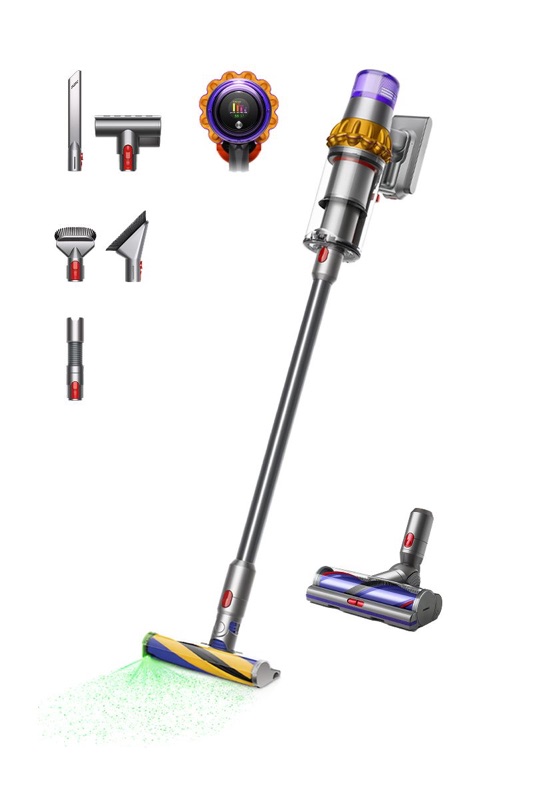
Dyson says the V15 is fully sealed and tested to ASTM F1977 at SGS Laboratory USA in 2024, the most specific vacuum claim we found. It is bagless, the report is not public, and no independent test lists it. We are asking for the report.
Best for A buyer who wants a cordless stick with a sealed, whole-machine filtration claim and a named test lab, and who accepts a bagless bin.
- Our quality rating
- Fair (3 of 5)
- Price range
- Premium
- Size
- Cordless stick; 240 Air Watts; up to 60 minutes (Dyson); 6.83 lb; 0.2-gallon bin
approx. $600 on sale with a car cleaning kit (list $889.99)
See it on Dyson’s site →We are not affiliated with Dyson. This link goes to the maker’s own page, with no tracking code. How we're funded.
Reader ratings & reviews
– out of 5
Loading ratings…
Rating breakdown
- 5 stars 0
- 4 stars 0
- 3 stars 0
- 2 stars 0
- 1 star 0
Have this product? Please rate it.
Check your email
We sent a sign-in link to . Click it and you’ll come straight back here, signed in. It expires in 15 minutes; check your spam folder if it doesn’t show up. Thank you for helping the community!
Your review
Reviews are personal experiences, not research, and they never change our quality ratings. Every review is read by our team before it appears.
How we evaluated it
Why we chose it What put it on our list
- Dyson’s page says the V15’s fully sealed, whole-machine filtration captures 99.9% of particles as small as 0.1 µm. Another feature line, and its spec table, say 99.99% to 0.3 µm. The feature lines carry a footnote: “Tested to ASTM F1977 in Boost mode at SGS Laboratory USA in 2024”.
- ASTM F1977 is a test of the whole vacuum. Dyson’s footnote says efficiency compares the dust taken in with the dust discharged, which is what our second criterion asks for, though the report is not public.
- Dyson says the filter is washable, with a reminder on the screen about once a month, and that the battery detaches in one click, with spare batteries sold.
- It costs about $600 on Dyson’s site with a car cleaning kit, against a list price of $889.99 (seen 2026-10-22), and carries a 2-year limited warranty.
Trade-offs What to weigh before you buy
- It is bagless. Dyson says the bin ejects dust into your household bin in one action, but we found no independent test of the dust you are exposed to when emptying. Our criteria prefer a bag.
- We found no independent test. The September 2026 Asthma & Allergy Friendly guide lists no Dyson vacuum, and the SGS report is not published.
- Dyson’s page does not name the filter grade. It calls the filtration whole-machine HEPA.
- We did not check replacement filter or battery prices.
What to know Details worth knowing first
Dyson’s vacuums say more about filtration than most. The V15 Detect page calls the machine fully sealed, says whole-machine filtration captures 99.9% of particles down to 0.1 µm, and names the standard (ASTM F1977), the mode (Boost), the lab (SGS Laboratory USA) and the year (2024). That is closer to a testable claim than the usual “HEPA filter” line, and it matches what our house dust guide says a vacuum should do: keep fine dust in the machine.
What we could not do is open the report, and nothing independent lists a Dyson vacuum. It is also bagless. Dyson’s bin ejects dirt in one motion, but a bagless bin is the design our criteria flag for anyone with dust allergies.
At about $600 on sale, it is a fair pick if you want a cordless stick with a named test behind its sealing claim. We are asking Dyson for the SGS report; until it arrives, the sealing and filtration claims stay Dyson’s own.
Quality & testing How it measures up against our checklist
| What we checked | What we found |
|---|---|
| A sealed system Maker’s claim | Dyson’s page says fully sealed, whole-machine filtration, tested to ASTM F1977 in Boost mode at SGS Laboratory USA in 2024. That is Dyson’s statement; we could not open the report. |
| HEPA on the exhaust Maker’s claim | Dyson calls it whole-machine HEPA filtration and gives 99.9% at 0.1 µm in one feature line and 99.99% at 0.3 µm in another and in its spec table; the feature lines share the same test footnote. No filter grade, no report. |
| Mess-free emptying Not verified | Bagless: a 0.2-gallon bin that ejects dirt in one action. No independent test of emptying exposure. |
| Parts you can buy Not verified | Dyson says the filter is washable, with a monthly reminder, and the battery detaches in one click. We did not check replacement prices. |
What the labels mean
- Verified We opened an independent record that confirms it: a certifier’s listing, a regulator’s list or a lab report. It is linked under Sources.
- Maker’s claim The maker says so on its own page or label. We read it but found no independent record.
- Not verified We looked and could not confirm it, or the maker does not say. Treat it as unknown.
Sources Where our facts come from
- Dyson V15 Detect Absolute product page, with footnote 8. Maker’s page. Price, specifications and footnote 8 as seen on 2026-10-22. Opens in a normal browser; dyson.com blocks automated fetches. Open ↗
- The Dyson Limited Warranty. Maker’s page. Lists a 2-year limited warranty for cordless vacuums. Open ↗
- Asthma & Allergy Friendly Certified Products Guide, September 2026. Certifier or regulator listing. Its vacuum cleaner list has LG, eufy and Rainbow products. It has no Dyson. Open ↗
Alternatives Other options to compare
- Miele Guard L1 Allergy About $749, bagged, with a HEPA exhaust filter as standard. We found no independent test, and Miele’s page does not say it is sealed.
- SEBO Airbelt K3 Premium About $949, bagged, with a maker statement of a tightly sealed casing. HEPA is an optional extra.
- A vacuum on the Asthma & Allergy Friendly list AAFA’s certificate tests for leaks and for dust released when emptying. Its September 2026 guide lists LG cordless, eufy robot and Rainbow vacuums, and no Dyson.