Products · Bottled water · Icelandic Glacial
Icelandic Glacial Natural Spring Water, still, 750 mL glass bottles
Reader ratings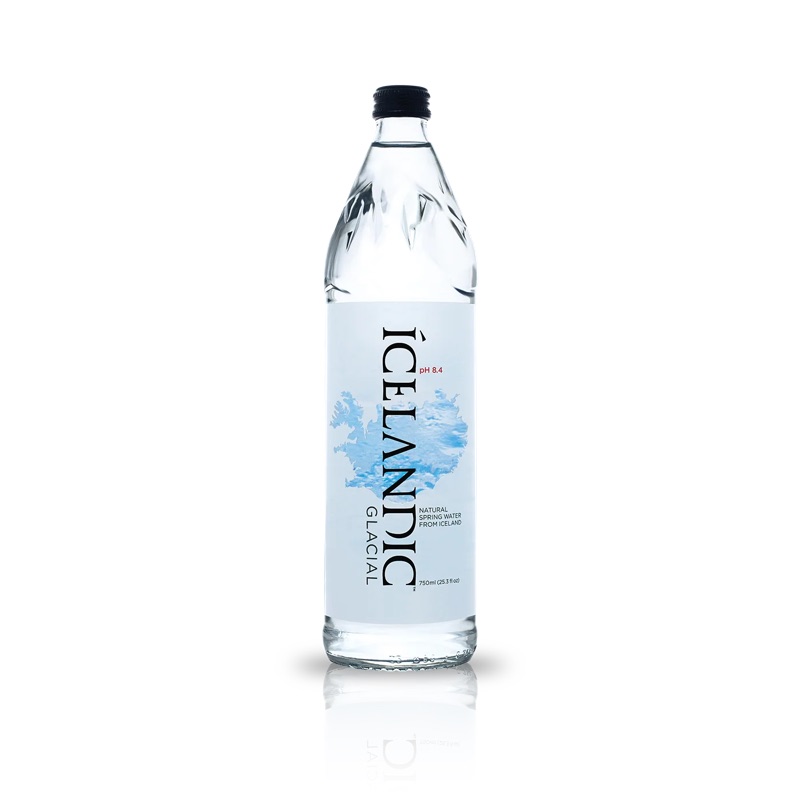
Glass-bottled Icelandic spring water. FDA found no PFAS in 12 retail samples, and the maker posts a 2026 NSF source report and a glass microplastics test. Its “certified free of all contaminants” line goes too far.
Best for People who want low-mineral spring water in glass with a recent, complete lab report, and who will pay reseller prices because the maker’s glass is sold out.
- Our rating
- Good (3.7 of 5)
- Price range
- Premium
- Size
- 750 mL glass bottle, 12 to a case (the maker also lists a 330 mL glass 24-pack, still and sparkling)
- Made in
- Ölfus Spring, southwest Iceland, bottled at the source
approx. $3.50 for one 750 mL glass bottle ($42 for 12 at the maker’s store, sold out on 2026-11-02 and 2026-11-03)
See it on Icelandic Glacial’s site → (opens in a new tab)We are not affiliated with Icelandic Glacial. This link goes to the maker’s own page, with no tracking code. How we're funded.
Also sold at Amazon ($57.99 for 12 x 25 fl oz glass bottles (about $4.83 a bottle)), Walmart.com ($58.25 for 12 x 25.3 oz glass bottles (about $4.85 a bottle)) .
Reader ratings & reviews
– out of 5
Loading ratings…
Rating breakdown
- 5 stars 0
- 4 stars 0
- 3 stars 0
- 2 stars 0
- 1 star 0
Have this product? Please rate it.
Check your email
We sent a sign-in link to . Click it and you’ll come straight back here, signed in. It expires in 15 minutes; check your spam folder if it doesn’t show up. Thank you for helping the community!
Your review
Reviews are personal experiences, not research, and they never change our quality ratings. Every review is read by our team before it appears.
How we evaluated it
How it scores Our rating, metric by metric
- Source 20% of the rating 4 of 5
A named spring and a full NSF source-water report with lab, sampling date and reporting limits. The report has no PFAS panel, and it tests the spring, not the bottled water.
- Independent testing 35% of the rating 4 of 5
No PFAS in 12 FDA retail samples; arsenic, lead and uranium not detected by NSF and no microplastics above reporting limits at Eurofins, both ordered by the maker. No TFA result.
- Packaging 25% of the rating 4 of 5
Glass with an aluminium screw closure per the Eurofins sample sheet. The closure liner is not stated, and cap paint can shed microplastics.
- Trust 10% of the rating 3 of 5
No recalls, Prop 65 notices or lawsuits found, but the glass page says the water is “certified free of all contaminants”, which no certificate we found says.
- Value 10% of the rating 2 of 5
About $3.50 a bottle at the maker ($4.67 a liter), sold out; resellers charge $4.83 to $4.85 a bottle, about $6.45 a liter.
The rating, 3.7 of 5, is the weighted average of these scores. See how we rank bottled water and our standard.
Where to buy Stores and the prices we saw
- Amazon (opens in a new tab) approx. $57.99 for 12 x 25 fl oz glass bottles (about $4.83 a bottle). Third-party sellers, not the maker or Amazon: 3285Craig was the featured seller on 2026-11-03, with Joyful Shoppe and The Bena Group at the same price. The Icelandic Glacial packs that Amazon itself sells (330 mL, 500 mL and 1 L) have titles that do not say glass.
- Walmart.com (opens in a new tab) approx. $58.25 for 12 x 25.3 oz glass bottles (about $4.85 a bottle). Marketplace seller Voodoux Sales, not Walmart or the maker, with free shipping, seen on 2026-11-03; a second seller starts at $60.95.
Prices as we saw them on November 3, 2026. They change often. These links carry no tracking code and earn us nothing.
What’s in it Every ingredient, in label order
- Natural spring water
Who tested it What each test found, and who paid for it
- Independent FDA laboratory survey (EPA method 537.1) April 2025
Tested 12 Icelandic Glacial samples bought at US retail in 2023 and 2024 for 18 PFAS. None was above the reporting limits of 0.23 to 0.32 ng/L. The file does not say which container each sample came in, and TFA is not in the panel. Open ↗ (opens in a new tab)
- Maker’s own test NSF International (test report ordered by the maker; the report says it is not an NSF certification) February 2026
Source spring water sampled 26 January 2026, final report 27 February 2026, tested to FDA’s bottled water rule (21 CFR 165.110). Not detected: arsenic (limit 0.001 mg/L), lead (0.0005), cadmium, uranium (0.001), fluoride (0.1), bromate and glyphosate. At those limits one 750 mL bottle would hold under 0.75 µg of arsenic and under 0.38 µg of lead. Found: nitrate 0.02 mg/L as N, sodium 11, calcium 5.5, magnesium 2.2, total dissolved solids 72, pH 8.49. The report has no PFAS results. Open ↗ (opens in a new tab)
- Maker’s own test Eurofins WEJ Contaminants, Hamburg (for Matís, Iceland, ordered by the maker) April 2026
Six glass bottles with aluminium screw closures, 330 mL of water analyzed by pyrolysis-GC-MS. Ten plastics (PE, PP, PS, ABS, PMMA, PC, PVC, PET, PA6, PA66) came back below limits of 0.1 to 7 µg/L. One sample, and the method reports polymer mass, not particle counts. The report gives no bottle size: the six containers weighed 3,686 g together, about 614 g each, which fits the 330 mL bottle better than the 750 mL one. Open ↗ (opens in a new tab)
Who paid, and why it matters
- Independent The tester took no money from the maker for it: a consumer group, a journalist, a university or a regulator.
- Paid certification An outside lab or certifier tested or listed it, and the maker paid for that.
- Maker’s own test A lab report or certificate of analysis the maker commissioned and published.
A certification is a floor, not a verdict: it checks what its program checks and nothing else. We weigh tests by someone with no stake in the result most.
What people ask Worries raised online and elsewhere, and what we found
- Does it contain PFAS, the “forever chemicals”?
- None that FDA could find: all 18 PFAS it tested for were below reporting limits in 12 samples (FDA results (opens in a new tab)). NSF’s 2026 report for the maker does not test PFAS, so the maker’s own paperwork does not cover them. TFA, a very short PFAS, is not in FDA’s panel, and we found no TFA test of this water. A 2024 PAN Europe test found it in 10 of 19 European mineral and spring waters (GLOBAL 2000 (opens in a new tab)), which is why the gap matters.
- Is it “certified free of all contaminants”, as the maker says?
- No certificate we found says so. The glass product page says the water is “certified free of all contaminants, such as PFAs, microplastics and forever chemicals”. What the maker posts is one NSF test report of the spring (not a certification, and with no PFAS panel) and one Eurofins microplastics test. Both are good results, and neither supports the word “all”.
- Does glass add microplastics?
- It can. France’s food-safety agency found 4.5 plastic particles per liter in glass-bottled water (opens in a new tab) against 1.6 in plastic, probably from cap paint. The maker’s Eurofins test found none above its limits in one 330 mL sample, probably from the smaller bottle, and it measured polymer mass, not particles, so the two results cannot be compared. See our microplastics guide.
- Is “naturally alkaline” water better for you?
- The pH is real (8.49 in NSF’s report; the maker says 8.4), and it comes from the rock, not additives. The benefit claims are another matter: see what the research says about alkaline water. We scored the water, not the pH.
- Can you buy it in glass?
- Hardly, from the maker. Its store listed the glass cases as sold out on 2026-11-02, with home delivery only in Los Angeles and Miami and a three-case minimum. Elsewhere it points to Amazon and a store locator we did not test. The glass we could open was from third-party sellers at about 38% over the maker’s price.
- Any recalls, lawsuits or warnings?
- None found. California’s Prop 65 notice search had no match for Icelandic on 2026-11-02, openFDA’s food enforcement search shows only an unrelated company (Icelandic Provisions, a 2018 skyr label error), and a web search found no suit or recall against Icelandic Water Holdings.
Why we chose it What put it on our list
- FDA found none of 18 PFAS in 12 Icelandic Glacial samples bought at US retail in 2023 and 2024, each below reporting limits of 0.23 to 0.32 ng/L.
- The maker posts a 13-page NSF report on the source spring, sampled 26 January 2026, with reporting limits: arsenic, lead, cadmium, uranium and fluoride not detected, and total dissolved solids of 72 mg/L.
- A Eurofins test of its glass bottles with screw closures (April 2026) found none of ten plastics above limits of 0.1 to 7 µg/L, which speaks to the worry about glass and plastic caps, though the bottles tested were probably the 330 mL size.
- It is low in sodium (11 mg/L) and comes from one named spring, bottled at the source with nothing added, per the maker.
Trade-offs What to weigh before you buy
- Both lab reports were ordered by the maker. The NSF report has no PFAS panel, and no one has published a TFA result for this water. The glass page’s “certified free of all contaminants” line goes further than any document it posts.
- The Eurofins report does not say which bottle size it tested: its six containers weighed 3,686 g together, about 614 g each, which fits the 330 mL bottle, not the 750 mL one. It also reports polymer mass in one 330 mL sample, so it cannot be compared with the French study’s particle counts for glass-bottled water, which pointed at cap paint.
- The maker’s glass cases were sold out on 2026-11-02, with home delivery only in Los Angeles and Miami. Resellers on Amazon and Walmart.com charge about $4.85 a bottle, 38% over the maker’s $3.50.
- At about $6.45 a liter from resellers it is the dearest water here, and at 72 mg/L of dissolved solids it will not add much calcium or magnesium.
What to know Details worth knowing first
Icelandic Glacial comes from the Ölfus Spring in southwest Iceland and is low in minerals: NSF measured 72 mg/L of dissolved solids and no arsenic, lead or uranium above its reporting limits. We list the glass bottle because the evidence is better than for most waters. FDA found none of 18 PFAS in 12 retail samples, and the maker posts a full spring report from January 2026 and a microplastics test of its glass bottles. Our guide to what PFAS are explains why the first of those matters.
Read the claims with care. The tests the maker posts were ordered by the maker, the NSF report has no PFAS panel, and nothing we found tests the water for TFA. The glass page says the water is “certified free of all contaminants”, and no certificate says that. The maker’s glass cases were also sold out when we looked, so what you can buy is usually a reseller’s case at about 38% over the maker’s price.
For everyday drinking a certified filter is cheaper and creates less waste, as our tap versus bottled water guide explains. Choose this water if you want a spring water in glass with a documented source, and keep it out of the sun like any other glass bottle.
What we checked Each claim, and how sure we are of it
| What we checked | What we found |
|---|---|
| A water-quality report Verified | A 13-page NSF report on the source spring, sampled 26 January 2026, with reporting limits. It covers metals, nitrate, uranium, solvents and pesticides, and has no PFAS results. |
| Low PFAS Verified | FDA’s survey found none of 18 PFAS in 12 Icelandic Glacial samples. The maker’s claim of “certified free” PFAS rests on no document we found. |
| Glass or aluminum, cap and liner stated Maker’s claim | Glass bottle with an aluminium screw closure, from the Eurofins sample sheet. The liner material is not stated. |
| A named source Maker’s claim | Ölfus Spring, southwest Iceland, bottled at the source with nothing added or taken away, per the maker. |
| Minerals stated Verified | NSF: total dissolved solids 72 mg/L, calcium 5.5, magnesium 2.2, sodium 11, potassium 0.7, sulfate 3.3, fluoride not detected, pH 8.49. The maker says 62 mg/L and pH 8.4. |
What the labels mean
- Verified We opened an independent record that confirms it: a certifier’s listing, a regulator’s list or a lab report. It is linked under Sources.
- Maker’s claim The maker says so on its own page or label. We read it but found no independent record.
- Not verified We looked and could not confirm it, or the maker does not say. Treat it as unknown.
Sources Where our facts come from
- Icelandic Glacial in Glass, maker’s product page. Maker’s page. Glass cases $42 for 12 x 750 mL and $44 for 24 x 330 mL, shown as sold out on 2026-11-02 and 2026-11-03; the “certified free of all contaminants” line is on this page. Open ↗ (opens in a new tab)
- Icelandic Glacial: reports and certifications. Maker’s page. Links the NSF and Eurofins reports, a Zenith source-sustainability report and a kosher certificate. Open ↗ (opens in a new tab)
- NSF test report, source spring water (27 February 2026). Test report. Ordered by the maker. Sampled 26 January 2026; the report says it is not NSF certification. Open ↗ (opens in a new tab)
- Eurofins microplastics report for glass bottles (29 April 2026). Test report. Ordered by the maker through Matís. Packaging type on the report: glass bottle with aluminium screw closure. Open ↗ (opens in a new tab)
- Icelandic Glacial: microplastics report page (29 April 2026). Maker’s page. The maker’s plain-language summary of the Eurofins result. Open ↗ (opens in a new tab)
- FDA: FDA Shares Testing Results for PFAS in Bottled Water (14 April 2025). Independent source. 197 samples bought at US retail in 2023 and 2024, tested for 18 PFAS. Open ↗ (opens in a new tab)
- FDA: Analytical Results for FY23-24 PFAS in Bottled Water Assignment (PDF). Test report. Results by sample number. Ten of 197 samples had any PFAS; none was an Icelandic Glacial sample. Open ↗ (opens in a new tab)
- FDA: FY23-24 PFAS in Bottled Water sample brand information (PDF). Test report. Maps sample numbers to brands: 12 samples are Icelandic Glacial (spring water, imported). Open ↗ (opens in a new tab)
- GLOBAL 2000: TFA in a spot-check of mineral waters (factsheet, German). Independent source. PAN Europe’s 2024 test of 19 European waters. It does not include Icelandic Glacial; used as context for the TFA gap. Open ↗ (opens in a new tab)
- ANSES: the caps of glass bottles contaminate beverages with microplastics (June 2025). Independent source. Beverages sold in France, not this brand. Water averaged 4.5 particles per liter in glass and 1.6 in plastic. Open ↗ (opens in a new tab)
- California Attorney General: Prop 65 60-day notice search. Certifier or regulator listing. Searched by alleged violator for “Icelandic” on 2026-11-02 and 2026-11-03: no matching records. The 11 notices that mention bottled water name other bottlers. Open ↗ (opens in a new tab)
- openFDA: food enforcement reports. Certifier or regulator listing. Searched 2026-11-02 and 2026-11-03 for the recalling firm and for “Icelandic Glacial”: one unrelated 2018 report (Icelandic Provisions), none for the water. Open ↗ (opens in a new tab)
- Amazon: Icelandic Glacial 12 x 25 fl oz glass bottles. Independent source. Third-party seller 3285Craig, $57.99, seen 2026-11-03. Open ↗ (opens in a new tab)
- Walmart.com: Icelandic Glacial 12 x 25.3 oz glass bottles. Independent source. Marketplace seller Voodoux Sales, $58.25, seen 2026-11-03. Open ↗ (opens in a new tab)
Alternatives Other options to compare
- Evian in glass French spring water with the best test record of the glass waters here: no PFAS in an NSF report or in 14 FDA samples.
- Mountain Valley Spring Water in glass The cheapest glass water per liter, though the maker’s own report is its only PFAS result.