Products · Kitchen tools & cleanup · Bambu
Bambu Classic Bamboo Cutting & Serving Board
Reader ratings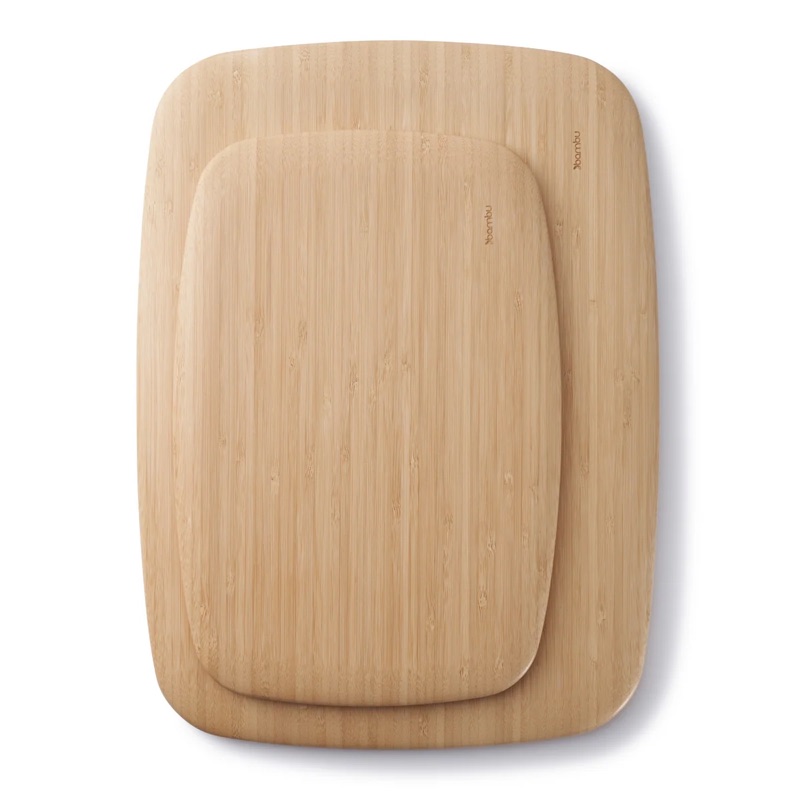
A reversible bamboo board whose maker says what holds it together (a water-based, food-grade, formaldehyde-free adhesive) and how it is finished (food-safe wood oil), without naming either. No lab report is published.
Best for Buyers who want a lighter, cheaper board than hardwood and will accept the maker’s description of the glue.
- Our quality rating
- Fair (3 of 5)
- Price range
- Mid-range
- Size
- Medium 12 x 8 x 5/8 in; large 15 x 11 x 3/4 in; reversible
- Made in
- Made in China
approx. $30.95 (medium); $43.95 (large)
See it on Bambu’s site →We are not affiliated with Bambu. This link goes to the maker’s own page, with no tracking code. How we're funded.
Reader ratings & reviews
– out of 5
Loading ratings…
Rating breakdown
- 5 stars 0
- 4 stars 0
- 3 stars 0
- 2 stars 0
- 1 star 0
Have this product? Please rate it.
Check your email
We sent a sign-in link to . Click it and you’ll come straight back here, signed in. It expires in 15 minutes; check your spam folder if it doesn’t show up. Thank you for helping the community!
Your review
Reviews are personal experiences, not research, and they never change our quality ratings. Every review is read by our team before it appears.
How we evaluated it
Why we chose it What put it on our list
- Bambu says what holds the board together: “a water-based, food-grade adhesive imported from Europe that contains no formaldehyde”, then “hand finished with food-safe wood oil”. Our category standard asks every bamboo board to say what glue it uses, and this one answers in general terms.
- The bamboo is sold as FSC®-certified 100% bamboo, with license code N004066 on the page. Bambu’s Proudly Made page says it is wild moso bamboo from eastern China, worked by small family-operated workshops in provinces near its Shanghai office.
- The price is published for both sizes: $30.95 for the 12 x 8 x 5/8 in board and $43.95 for the 15 x 11 x 3/4 in board.
Trade-offs What to weigh before you buy
- The adhesive and the oil are described, not named, so a reader cannot look either one up. Teakhaus names its glue and finish; Bambu does not.
- The testing is described, not shown. Bambu’s Testing & Materials page says products pass independent laboratory tests and that a third party certifies compliance with FDA and CPSC requirements, but names no lab and links no report.
- Bambu’s page for another board says its cutting boards are “biobased certified, ensuring no toxins”. A biobased label speaks to how much of a product comes from plants, not to what the glue contains, so we did not count it as evidence about the adhesive.
- We found no study of bamboo boards themselves. Our cutting-board guide says solid bamboo boards are strips bonded together, and that the research concerns bamboo-fiber melamine tableware, not boards.
What to know Details worth knowing first
Bamboo boards are made of bamboo strips pressed and glued together, so the glue is the question to ask. Our cutting-board guide explains that the research on bamboo concerns bamboo-fiber melamine tableware, which can release formaldehyde, and not solid bamboo boards. Our formaldehyde guide covers why a formaldehyde-free adhesive is worth asking for.
Bambu answers in general terms: a water-based, food-grade adhesive with no formaldehyde, and a food-safe wood oil. That is a real answer to the question, but it is still the maker’s word. It does not name the glue or the oil, and it shows no lab report.
We list it at 3 because of that gap. If the adhesive matters to you, ask Bambu for its safety data, or choose a board whose maker names the glue.
Quality & testing How it measures up against our checklist
| What we checked | What we found |
|---|---|
| Named materials and glue Maker’s claim | 100% bamboo, joined with a “water-based, food-grade adhesive imported from Europe that contains no formaldehyde”. The adhesive is not named. |
| Finish or coating stated Maker’s claim | “Hand finished with food-safe wood oil”. The oil is not named. |
| No antimicrobial treatments Not verified | Not stated on the product page. |
| Plastic-free where it wears Maker’s claim | Bamboo, adhesive and oil. No plastic is listed. |
| Safe by design Maker’s claim | No metal fittings or bristles. |
| Easy to clean or replace Maker’s claim | The product page has no care instructions. Bambu’s Testing & Materials page recommends its own finishing oil rather than mineral oil. |
| Independent testing Not verified | Described on Bambu’s site, but no lab is named and no report is published. |
| Company certifications Maker’s claim | Bambu says it has been a Certified B Corp since 2018 and biobased certified since 2011. We did not check B Lab’s directory or USDA’s BioPreferred catalog, and neither mark certifies the glue. |
| Recalls Verified | We searched the CPSC recall database for “Bambu” on 2026-10-22. It returned one recall, of Bambu Lab 3D printers, a different company. None for bambu® kitchenware. |
What the labels mean
- Verified We opened an independent record that confirms it: a certifier’s listing, a regulator’s list or a lab report. It is linked under Sources.
- Maker’s claim The maker says so on its own page or label. We read it but found no independent record.
- Not verified We looked and could not confirm it, or the maker does not say. Treat it as unknown.
Sources Where our facts come from
- Bambu Classic Bamboo Cutting & Serving Boards product page. Maker’s page. Open ↗
- Bambu Testing & Materials. Maker’s page. Open ↗
- Bambu Proudly Made (origin and sourcing). Maker’s page. Open ↗
- Bambu Certifications. Maker’s page. Open ↗
- Bambu Arch Bread Board product page (source of the “biobased certified” quote). Maker’s page. Open ↗
- CPSC recall search for “Bambu”, run 2026-10-22. Certifier or regulator listing. JSON results: one recall (Bambu Lab 3D printers, 2024), unrelated to this maker. Open ↗
Alternatives Other options to compare
- Teakhaus Butcher Block Cutting Board 317 A teak end-grain board for about $54 whose maker names its glue (KOYOBOND) and finish (mineral oil and beeswax).
- Bambu Kitchen Basics bamboo utensils Made from single pieces of bamboo, so there is no glue to ask about.